
Our Dazzling Neighbour
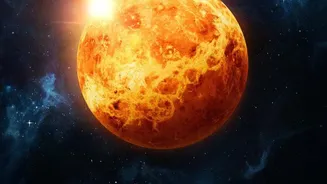
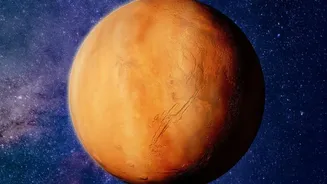
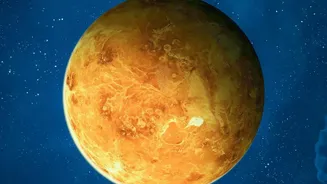
Venus often gets mistaken for an aircraft or a distant star, but its brilliance is in a class of its own. It’s the brightest natural object in our night sky after the Moon. The reason for its dazzling appearance is twofold: it’s relatively close to us,
and its entire surface is shrouded in thick, highly reflective clouds. These clouds act like a giant mirror, bouncing sunlight back towards us, which is why Venus can appear so intensely bright, even piercing through the evening twilight before the sky is fully dark. Unlike stars that twinkle due to the Earth's atmospheric turbulence, Venus shines with a steady, unwavering light, making it easy to distinguish. This month, it's particularly well-placed for viewing, offering a perfect opportunity for even the most casual sky-watcher to connect with our solar system.
When and Where to Look
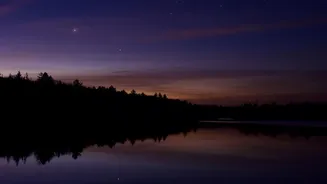
Timing and direction are everything when it comes to spotting planets. For Venus this August, your cue is the sunset. Find a spot with a clear view of the western horizon, away from tall buildings or trees if possible. The best time to begin your search is about 30 to 45 minutes after the sun has completely set. As the deep blue of twilight settles in, Venus will emerge as a brilliant point of light. It will be visible in the west-southwestern part of the sky. Don't wait too long, as the planet itself will set roughly 90 minutes after the sun. Mid-August is an especially good time for viewing. Around August 14-16, Venus reaches what astronomers call its 'greatest elongation', meaning it will be at its farthest apparent distance from the sun, making it stand out more clearly against the darkening sky.
Using Stars as Your Guide
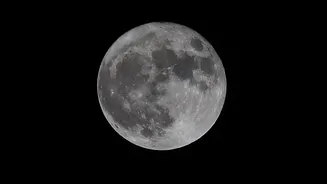
While Venus is bright enough to find on its own, you can use other celestial objects as signposts. Throughout August, Venus is travelling across the constellation of Virgo. To help you get your bearings, look for a bright star nearby—that will be Spica, Virgo’s brightest star. As the month progresses, you will notice Venus drawing closer and closer to Spica, creating a beautiful and dynamic celestial scene. On the evening of August 15, you'll have an even easier guide: a lovely crescent Moon will be visible near Venus, pointing the way to the planet. This celestial pairing of the Moon and Venus is a stunning sight and a fantastic photo opportunity for those with a capable camera.
Tips for the Best Viewing Experience
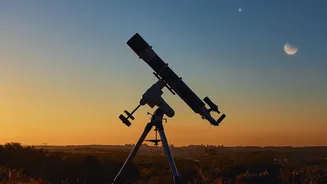
You don’t need any special equipment to see Venus; its brightness makes it an easy naked-eye target. However, a few simple tips can enhance your experience. First, give your eyes time to adapt to the darkness—at least 15 minutes away from bright screens or lights will help you see more detail in the night sky. If you have a pair of binoculars, you’ll be in for a treat. While they won’t show surface details, they will make Venus appear as a distinct disc of light rather than just a point. Through binoculars or a small telescope, you can even observe its phase. Just like the Moon, Venus goes through phases, and in August it will appear as a tiny half-lit or crescent shape. Finally, consider downloading a stargazing app like Stellarium or Sky Guide. These apps use your phone's location to show you a real-time map of the sky, making it incredibly simple to confirm that the bright object you're looking at is indeed Venus.