





Meet 'Pushpak': India's Space Shuttle
Imagine if an airline had to build a brand-new aircraft for every single flight. That's how rocket launches have traditionally worked—immensely expensive, with most of the vehicle becoming space debris or falling into the ocean. The Indian Space Research
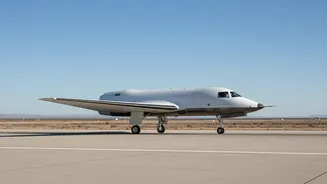
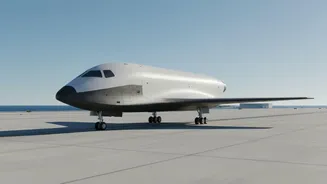
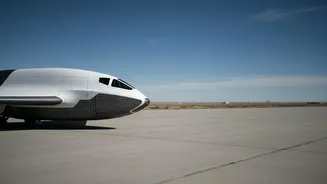
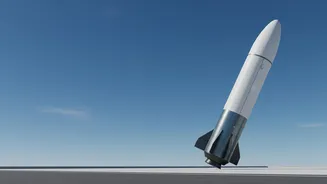
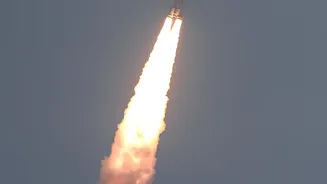
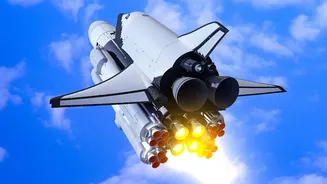
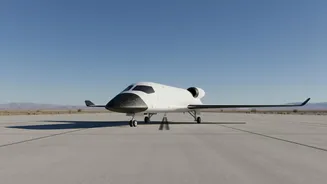
Organisation (ISRO) is set to change this with its Reusable Launch Vehicle (RLV) program, nicknamed 'Pushpak'. This winged vehicle is designed to function like a spaceplane; it will be launched vertically on a rocket, deploy a payload in orbit, and then fly back to Earth, landing horizontally on a runway just like an airplane. The goal is to reuse the most expensive parts of the launch system, particularly the upper stage with its sophisticated electronics and avionics, which can account for a huge chunk of the total cost. By mastering this technology, ISRO aims to drastically cut the cost of launching satellites.
Acing the Critical Landing Tests
Before Pushpak can fly to orbit, it must first prove it can land safely and autonomously from high altitude. ISRO recently completed a hat-trick of successful Landing Experiments (LEX) at the Aeronautical Test Range in Chitradurga, Karnataka. In the final and most challenging test, Pushpak was carried to an altitude of 4.5 km by an Indian Air Force Chinook helicopter and released. From there, it had to autonomously navigate its way to the runway, correcting for strong winds and a significant off-course starting position, and execute a perfect landing at a speed exceeding 320 kmph—faster than a typical fighter jet. To achieve this, the vehicle uses a suite of advanced, indigenously developed technologies, including India's own NavIC satellite navigation system. Crucially, the same vehicle was used in the second and third tests, proving the robustness of the hardware and its reusability.
The Billion-Dollar Question: How It Slashes Costs
The primary driver behind developing reusable vehicles is economics. A significant portion of a rocket's cost—sometimes as much as 60-80%—is tied up in the hardware of the rocket stages themselves, not the fuel. By recovering and reusing these complex systems, the cost per launch can be reduced dramatically. ISRO's long-term goal is to lower the cost of placing a kilogram of payload into Low Earth Orbit by up to 80%, potentially bringing it down from around $20,000 to $4,000 or even lower. This would make India an even more attractive destination for international clients looking to launch their satellites. In a booming global space economy, being a low-cost provider is a massive competitive advantage. It opens the door for more frequent launches, supporting everything from large satellite constellations for internet services to scientific missions and human spaceflight.
India's Place in the Global Space Race
With the success of the RLV landing tests, India joins an elite club of nations developing reusable spaceplane technology. While private companies like SpaceX have pioneered reusable rocket boosters that land vertically, ISRO's winged-body vehicle represents a different and complex approach. This positions India not just as a reliable and cost-effective launch provider, but as a hub of cutting-edge innovation. The nation already holds a share of the global space economy and aims to grow it significantly in the coming years. By developing its own reusable technology, ISRO reduces reliance on foreign systems and builds self-reliant, 'atmanirbhar' capabilities that will be crucial for ambitious future projects, including the Gaganyaan human spaceflight mission and the establishment of an Indian space station, the Bharatiya Antariksh Station.
What’s Next on the Roadmap?
With the landing experiments successfully concluded, ISRO's focus now shifts to the next major milestone: the Orbital Re-entry Experiment (ORE). This will involve launching Pushpak into orbit on a conventional rocket. After completing its mission, it will have to survive the fiery re-entry into Earth's atmosphere—a phase that tests its heat-resistant materials—before performing its autonomous approach and landing. This is the ultimate test of the vehicle's design and will validate its capability for operational flights. Alongside the Pushpak program, ISRO is also developing a Next Generation Launch Vehicle (NGLV), which is planned to be a partially reusable, heavy-lift rocket. Together, these two programs represent a comprehensive strategy to secure India's future in space for decades to come.