




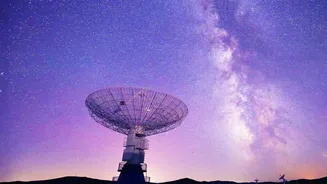
A Telescope of Unprecedented Scale
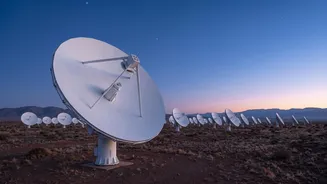
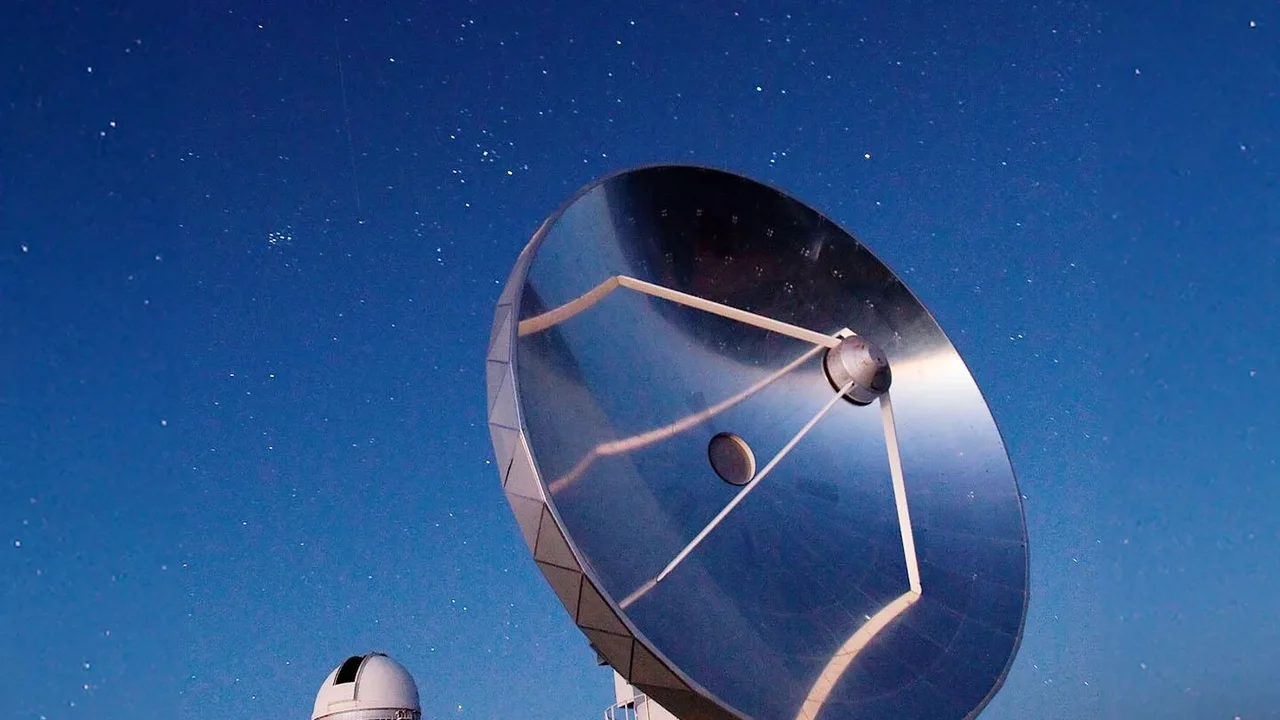
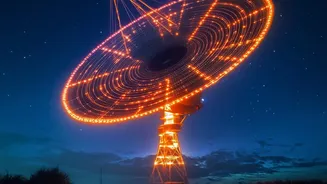
The Square Kilometre Array isn't a single telescope but a gigantic, coordinated network of antennas. Split across two continents, it is one of the most ambitious science projects in history. In the Karoo desert of South Africa, the SKA-Mid component will
eventually consist of 197 traditional dish antennas, including the existing 64-dish MeerKAT array. Meanwhile, in the remote Murchison region of Western Australia, SKA-Low will comprise over 131,000 small, Christmas-tree-like antennas. The name comes from the ultimate goal: a total collecting area of one square kilometre. This immense scale, coordinated by the SKA Observatory headquartered in the UK, is necessary for one reason: sensitivity. To hear the faintest and most distant signals in the cosmos, you need the biggest ear you can build.
The Art of Listening Together
So, how do thousands of antennas spread across kilometres of desert act as one? The technique is called interferometry. Each antenna in the array receives faint radio waves from space. These signals are digitised and sent via fibre optic cables to a central processing facility. There, supercomputers combine the data from every single antenna. By precisely correlating the timing of the signals arriving at each antenna, astronomers can reconstruct an image of the sky with incredible detail. The larger the distance between the antennas, the higher the resolution, allowing the SKA to see the universe with unparalleled sharpness. Essentially, the array simulates a single virtual telescope with a diameter as large as the entire network, capable of spotting details that would be impossible for any individual dish to resolve. The data processing challenge is enormous, expected to generate more traffic than the entire internet.
Tuning into the Cosmic Dawn
The SKA's most profound quest is to peer back into a mysterious period known as the 'Cosmic Dawn' and the subsequent 'Epoch of Reionization'. For hundreds of millions of years after the Big Bang, the universe was a dark, foggy place filled with neutral hydrogen gas. Then, the very first stars and galaxies began to form, and their intense radiation started to ionize the hydrogen, like trillions of tiny light bulbs burning away a cosmic fog. This process left behind a very specific, faint radio signal, known as the 21cm line emission. This signal, stretched by the expansion of the universe over billions of years, now arrives at Earth as a low-frequency radio wave. The SKA-Low telescope in Australia is specifically designed to detect this incredibly weak whisper from the past, which holds the secrets of how the first luminous objects in the universe came to be.
Answering Our Oldest Questions
By capturing and mapping this 21cm signal, the SKA will essentially create a 3D movie of the early universe switching on. For the first time, we will 'see' the birth of the first stars and the formation of the first galaxies. But the science goals don't stop there. The SKA will also be a powerful tool to test Einstein's theories of gravity by timing the signals from pulsars—ultradense, spinning stars—with exquisite precision. It will map the structure of cosmic magnetism, explore the evolution of galaxies over billions of years, and even contribute to the search for the molecular building blocks of life in space. With its unprecedented sensitivity, the array is poised to make discoveries that we can't yet even predict, pushing the boundaries of what we know about our place in the cosmos.