







Beyond Human Speed and Scale
Traditional weather forecasting relies on massive supercomputers running complex physics-based simulations. These models are powerful but incredibly demanding, requiring huge amounts of time and energy to produce a forecast. Machine learning (ML) offers
a different approach. Instead of solving intricate physical equations from scratch for every forecast, ML models are trained on decades of historical weather data. They learn to recognise patterns—how weather systems tend to behave—and then apply that knowledge to current atmospheric conditions to predict what will happen next. The result is a dramatic increase in speed. A forecast that might take a traditional model hours can be generated by a trained AI in minutes, often on a single powerful graphics card (GPU) instead of a supercomputer cluster. This efficiency is not just about convenience; it is democratising access to high-quality weather prediction.
Sharper Forecasts, Smarter Decisions
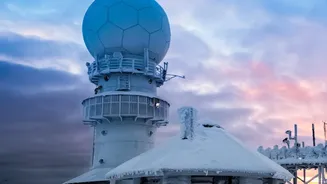
The new generation of AI weather models, such as Google's GraphCast and NVIDIA's FourCastNet, are delivering forecasts that are not only faster but also increasingly accurate. These systems can process enormous datasets from satellites, radar, and ground stations in real-time, allowing them to refine predictions continuously. This has led to the rise of hyper-local forecasting, with some models now able to provide rainfall predictions with a resolution as fine as a few hundred metres. For India, this capability is transformative. The India Meteorological Department (IMD) is integrating these global AI models into its systems to improve predictions for complex phenomena like monsoon variability and cyclone paths. More accurate, localised warnings allow farmers to better time their planting to coincide with rains and help authorities issue more precise evacuation orders ahead of extreme weather, saving lives and livelihoods.
Modeling Our Long-Term Climate Future
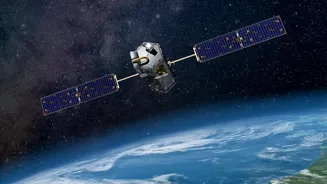
Beyond daily weather, machine learning is a critical tool in the broader fight against climate change. Climate models that simulate changes over decades are essential for understanding the future impacts of global warming, from sea-level rise to the frequency of heatwaves. ML can accelerate these time-intensive simulations, allowing for faster and higher-resolution outputs. It also helps scientists make sense of incomplete information. For instance, AI can analyse satellite imagery to track deforestation or estimate greenhouse gas emissions in areas where on-the-ground data is scarce. Furthermore, machine learning models can be used to simulate carbon sequestration and help design more efficient carbon capture systems. This ability to process and find patterns in vast, complex environmental datasets is helping scientists study the physics of our climate in ways that were previously impossible.
A Powerful Tool, Not a Magic Bullet
Despite its immense potential, machine learning is not a cure-all. A major challenge, particularly in regions like the Himalayas, is the lack of high-quality, long-term data needed to train the models effectively. Without robust data, AI predictions can be unreliable. Experts also caution that many deep learning models operate as "black boxes," making it difficult for scientists to understand precisely how they arrived at a prediction. This is especially risky when forecasting unprecedented climate extremes, as AI models are trained on past events and can struggle to predict conditions they have never seen before. For this reason, the most effective approach is often a hybrid one, where AI handles speed and pattern recognition, while human experts apply judgment, interpret the outputs, and communicate the risks. The partnership between AI and human scientists remains crucial.