





A Violent Heart on Our Cosmic Doorstep
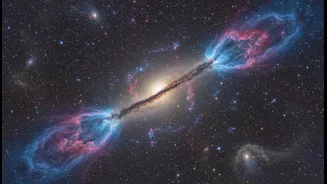
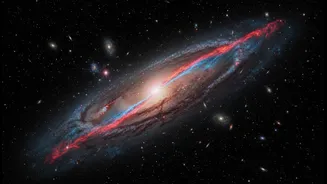
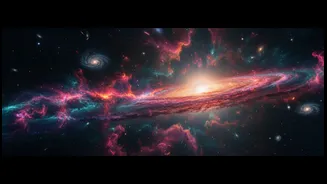
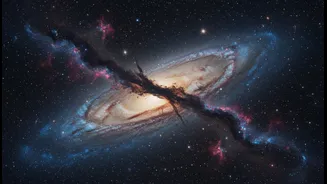
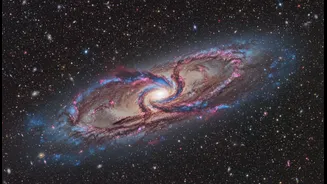
Centaurus A is not your average galaxy. Visually, it’s a stunning but strange object, an elliptical galaxy wrapped in a dark, parallelogram-shaped lane of dust. This unusual structure is the first clue to its turbulent past. At its core lies a supermassive
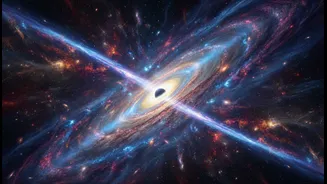
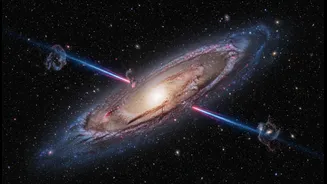
black hole actively feeding on gas and dust, launching powerful jets of energy far into space. This makes it an 'active galaxy' and a perfect natural laboratory for understanding some of the universe's most extreme processes. For decades, astronomers knew this chaotic engine was there, but the very dust that fuels the black hole also blocked our view, preventing telescopes like Hubble from peering into the galaxy's core in visible light.
Piercing the Veil with Infrared Light
The game-changer is the James Webb Space Telescope (JWST). By observing the universe in infrared light, Webb can see what was previously invisible. Infrared wavelengths can penetrate the thick clouds of cosmic dust, much like an X-ray allows doctors to see bones through skin. This new capability marks the beginning of Centaurus A's “infrared era.” What was once an obscured, hazy region is now being resolved with stunning clarity. To celebrate its fourth year of operations, NASA released new images from Webb that combine the views of its Near-Infrared Camera (NIRCam) and Mid-Infrared Instrument (MIRI), giving astronomers an unprecedented look at the galaxy's inner workings.
A Story Written in the Stars
The new images are breathtaking. Instead of a smooth glow, Webb reveals a dense tapestry of millions of individual stars. For the first time, astronomers can distinguish between different generations of stars within the galaxy's core. This is like a form of galactic archaeology; by studying the age and distribution of stars, scientists can create a timeline of Centaurus A's history. They can identify which stars existed before a cataclysmic event, which were born during it, and which formed more recently. These stellar populations hold the key to understanding the galaxy's evolution with a precision that was impossible just a few years ago.
Scars of a Galactic Collision
Webb's observations confirm that Centaurus A is the product of a massive collision with a smaller, gas-rich galaxy about two billion years ago. The iconic dust lane is a warped disk of material left over from this ancient merger. The infrared views expose intricate filaments, glowing clouds of warm dust, and even a mysterious S-shaped structure near the core that scientists are still working to understand. These detailed features are the visible scars of that cosmic crash, providing a vivid record of how such mergers reshape galaxies and trigger bursts of new activity.
The Black Hole's Dual Role
One of the biggest questions in astrophysics is how a galaxy's central black hole influences the entire system. Centaurus A is providing some of the clearest answers yet. Webb's instruments can measure the movement of gas near the black hole, revealing a complex dance. The data shows the black hole has a dual personality: it acts as both a creator and a destroyer. On one hand, the pressure from its energetic jets can compress surrounding gas clouds, triggering the birth of new stars. On the other hand, those same powerful jets can also blast away the raw materials for star formation, effectively shutting it down. Observing this delicate and violent balance up close helps explain why the most massive galaxies in the universe often stop making new stars.