






A Forest on the Frontline
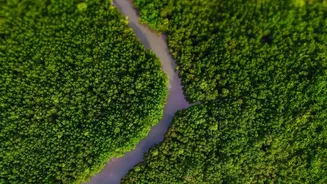
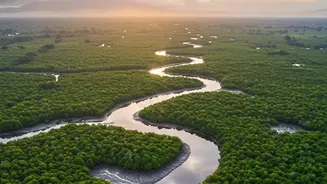
The Sundarbans, the world’s largest mangrove forest spanning India and Bangladesh, is more than just a UNESCO World Heritage site. It is a critical buffer for millions of people, a natural shield against the cyclones and storm surges that regularly batter
the coast. This unique ecosystem, where land, freshwater, and sea meet, is a biodiversity hotspot and a lifeline for coastal communities who depend on it for everything from fishing to honey collection. However, for decades, these vital forests have faced threats from deforestation, unsustainable aquaculture, pollution, and rising sea levels, leading to significant degradation.
The Science of 'Blue Carbon'
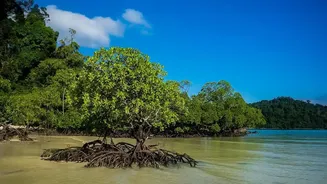
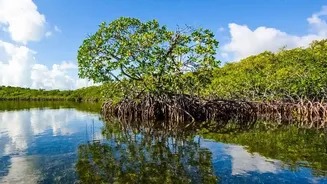
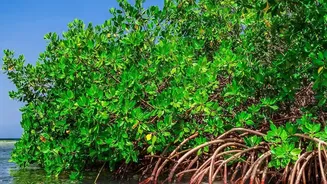
So, why are mangroves such superstars when it comes to fighting climate change? The secret lies in something called 'blue carbon'. This refers to the carbon captured by the world's ocean and coastal ecosystems. Unlike terrestrial forests, mangroves are exceptionally efficient at this job. They trap vast quantities of organic carbon in their complex underwater root systems and the dense, waterlogged soil they grow in. Because this soil is low in oxygen, the decomposition of organic matter is extremely slow. This means the carbon gets locked away for centuries, or even millennia, instead of being released back into the atmosphere. This makes mangroves one of the planet's most effective natural carbon sinks.
The Restoration Story
Recognising the immense value of the Sundarbans, significant efforts have been underway to bring degraded areas back to life. Community-led initiatives and large-scale projects, sometimes supported by organisations like the UN Environment Programme, have focused on replanting native mangrove species across thousands of hectares. These restoration projects are not just about planting trees; they often involve complex ecological work, such as digging canal networks to flush out excess salinity from the soil, creating the right conditions for the saplings to thrive. Recent data shows these efforts are paying off, with India's overall mangrove cover showing expansion in recent years, bucking a previous global trend of decline.
Eyes in the Sky: How Satellites See Carbon
The headline claim of 'record carbon levels' comes from advanced remote sensing technology. Scientists can't directly see carbon from space, but they can measure proxies for it with remarkable accuracy. Satellites equipped with technologies like LiDAR (Light Detection and Ranging) or Synthetic Aperture Radar (SAR) can penetrate forest canopies to measure tree height, density, and overall biomass—the total weight of trunks, branches, and roots. By combining this satellite data with on-the-ground measurements, researchers create sophisticated models that estimate the total carbon stored in a forest. Platforms like the Google Earth Engine allow scientists to process vast amounts of data from satellites like Sentinel-1 and Sentinel-2 to monitor changes in mangrove health and productivity over time.
Why Restored Forests Are So Powerful
Interestingly, recent global studies show that young, restored mangrove forests are particularly effective at sequestering carbon. While mature, old-growth forests hold vast stocks of carbon, younger, fast-growing trees absorb carbon from the atmosphere at a very high rate. Research indicates that planted mangroves can accumulate a significant percentage of the carbon stocks of natural forests within just a couple of decades. One global analysis even found that certain species of planted mangroves can sequester more carbon in their biomass than natural stands after 40 years. This rapid growth and high rate of carbon uptake in restored areas like those in the Sundarbans are what the satellite surveys are detecting, highlighting their immense potential as a climate solution.