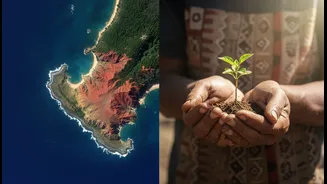









Two Ways of Seeing
Imagine trying to understand a complex story by only reading every hundredth page. That’s what it’s like to monitor coastal health using only satellite data. Satellites provide invaluable, large-scale information about sea-level rise, water quality, and mangrove
cover. This data helps scientists identify broad trends and urgent threats. However, this view from space is incomplete. It often misses the fine-grained details and the deep historical context that coastal Indigenous communities possess. This is where Traditional Ecological Knowledge (TEK) becomes essential. Passed down through generations, this lived knowledge includes a profound understanding of local species, seasonal cycles, and subtle environmental shifts that satellite sensors cannot detect. For millennia, these communities have been the primary stewards of their lands and waters, accumulating a dynamic and holistic understanding of their environment.
The Power of Partnership
When these two knowledge systems—the technological and the traditional—are brought together respectfully, the results can be transformative. In the Arctic, Indigenous knowledge about sea ice patterns has been integrated with AI and satellite data to create better prediction models, aiding local communities in adapting to climate change. In Australia, collaborations between Indigenous rangers and scientists have led to more effective management of marine parks, blending ancient wisdom with modern monitoring techniques. A recent project in Maine, USA, brought together elders' stories of the changing coastline with NASA satellite imagery to give students a richer understanding of erosion. These partnerships aren't just about adding a new layer of data; they create a more complete, nuanced, and culturally relevant picture of environmental change, leading to better and more just outcomes.
The Risk of Extraction
The problem arises when the relationship is not a partnership but an extraction. For too long, scientific and state-led projects have treated Indigenous knowledge as a raw resource to be collected, often without proper consent, context, or benefit to the community. This approach can lead to data being misinterpreted, misused, or commercialized without permission. There's a significant concern that a 'conservation by algorithm' approach, driven purely by remote sensing data, can exclude local people from decision-making processes about their own lands and waters. This not only disrespects the communities but also leads to less effective conservation, as it ignores the vital human element and the complex social relationships tied to the environment. Without true collaboration, even well-intentioned projects risk reinforcing colonial power dynamics.
Defining Data Sovereignty
This is where the concept of Indigenous Data Sovereignty becomes critical. It is the right of Indigenous peoples to govern the collection, ownership, and application of their own data. This includes information about their peoples, lands, and knowledge systems. It asserts that Indigenous communities are not merely subjects to be studied but are nations with the inherent right to control their own information. This framework is increasingly supported by international agreements like the United Nations Declaration on the Rights of Indigenous Peoples. It challenges the open-data movement's assumption that all information should be freely shareable, arguing that context, power, and history matter.
Putting Respect into Practice with CARE
To guide ethical partnerships, the Global Indigenous Data Alliance developed the CARE Principles for Indigenous Data Governance. These principles—Collective Benefit, Authority to Control, Responsibility, and Ethics—provide a clear framework. They state that data should benefit the community it comes from (Collective Benefit), that communities must have the authority to decide how their data is used (Authority to Control), that researchers have a duty to be accountable to these communities (Responsibility), and that the rights and wellbeing of Indigenous peoples must be the primary concern throughout the process (Ethics). Adhering to these principles means moving beyond simple consultation and toward genuine co-production of knowledge, where Indigenous partners are involved at every stage, from project design to data management and interpretation.