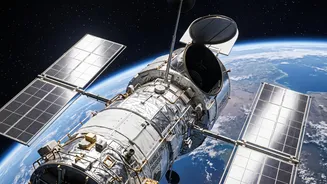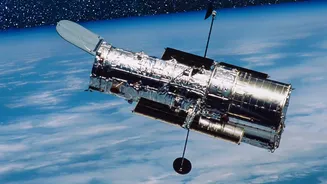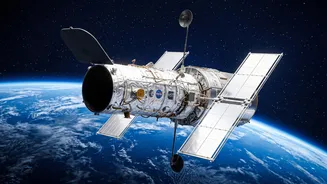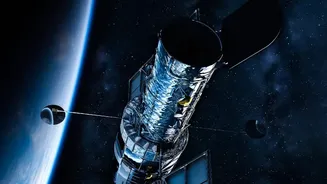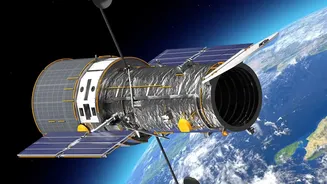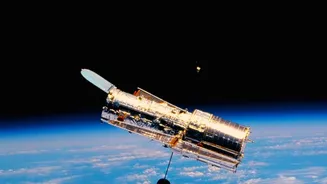




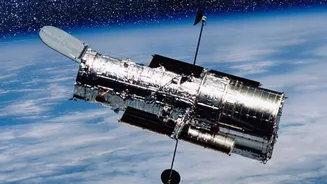
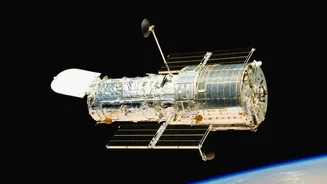
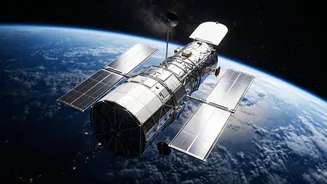
For over 35 years, the Hubble Space Telescope has been humanity’s window to the cosmos. Now, as its orbit slowly decays, NASA is looking for a private-sector hero to help write the next chapter for this legendary observatory.
A Legacy in the Stars
Since its launch in 1990,
the Hubble Space Telescope has transformed our understanding of the universe. From providing definitive evidence of supermassive black holes to helping determine the age and expansion rate of the universe, its contributions are immeasurable. The telescope has delivered breathtaking images like the 'Pillars of Creation' and led to the publication of thousands of scientific papers. It remains one of the most productive scientific instruments ever built, and even after three decades, demand for its observation time is incredibly high. Hubble was uniquely designed to be serviced in space by astronauts, receiving five upgrades during the Space Shuttle era, which kept its technology at the cutting edge. But with the shuttles retired, it now faces its greatest challenge alone.
The Inevitable Descent
Hubble circles the Earth in a low orbit, where the atmosphere, though incredibly thin, still creates a tiny amount of drag. Over time, this atmospheric friction has been slowly pulling the school bus-sized observatory downward. Initially orbiting at around 600 kilometers, it now sits at approximately 470 kilometers and is falling at a rate of about 14 kilometers per year. This orbital decay has been accelerated by recent solar activity, which causes the upper atmosphere to swell and increase drag. Without intervention, NASA projects Hubble could make an uncontrolled reentry into Earth's atmosphere sometime between 2033 and 2034.
A Call for Commercial Heroes
In a sign of the new space age, NASA has formally turned to the private sector for help. In late October 2026, the agency issued a Request for Information (RFI), asking commercial space companies for ideas on how to save the iconic telescope. The RFI isn't a formal contract but a market survey to see what's technologically and financially feasible. NASA has outlined three main options: a 'reboost' mission to push Hubble into a higher, more stable orbit; a servicing mission to upgrade its systems; or a mission to guide it to a safe, controlled disposal in the ocean. Companies have until November 30, 2026, to submit their concepts.
Potential Rescue Plans
This isn't the first time a commercial rescue has been discussed. In 2022, billionaire Jared Isaacman, through his Polaris Program, proposed a privately funded mission using a SpaceX Dragon spacecraft to reboost Hubble. A joint study between NASA and SpaceX concluded such a mission was technically feasible but didn't move forward at the time. Now, with the new RFI, the door is open for SpaceX and others to present updated plans. A successful reboost to an altitude of 600 kilometers could add another 15 to 25 years to Hubble's life, allowing it to continue its work until its designated successor, the Habitable Worlds Observatory, is potentially launched in the 2040s.
A New Era for Space
Any mission to Hubble is complex and risky. A commercial crew would have to rendezvous with and capture a telescope not originally designed for docking with a modern spacecraft. The provider would be responsible for the entire mission, from launch vehicle to operations, and crew if applicable. However, the challenge represents a significant business opportunity. A successful mission would pioneer a new market for in_space servicing of satellites, a capability that could become crucial for managing valuable assets in orbit. It would mark a pivotal moment in the partnership between government agencies and commercial enterprise, demonstrating how private innovation can help sustain and extend our most important scientific endeavors.