




The Era of Counting Grams
Not long ago, the conversation around protein was dominated by a single number. Whether on fitness apps or nutrition labels, the total gram count was king. The goal was straightforward: consume a certain amount, often calculated based on body weight,
to support everything from muscle growth to overall health. This approach wasn't wrong, but it was incomplete. It provided a useful, simple metric that helped people become more aware of their protein intake. However, it overlooked crucial factors that determine how effectively our bodies can actually use the protein we eat. This simplistic view is now giving way to a more nuanced understanding, one that values quality over sheer quantity.
Quality Over Quantity: The Amino Acid Profile
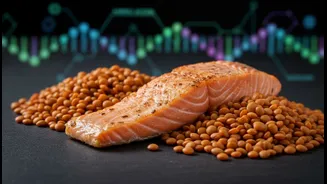
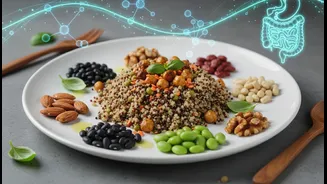
At its core, a protein is a chain of building blocks called amino acids. There are 20 different amino acids, nine of which are considered 'essential' because our bodies cannot produce them—we must get them from food. This is where the concept of 'protein quality' comes in. A 'complete' protein contains all nine essential amino acids in sufficient amounts. Animal sources like meat, eggs, and dairy are typically complete proteins. Most plant-based proteins are 'incomplete', meaning they are low in one or more essential amino acids. However, this doesn't make them inferior. By combining different plant sources—like the classic Indian pairing of dal (lentils) and rice—you can easily create a complete amino acid profile, ensuring your body gets all the building blocks it needs.
The Leucine Trigger: Your Muscle's On-Switch
Among the essential amino acids, one stands out for its powerful role in muscle health: leucine. Think of leucine as the master switch for muscle protein synthesis—the process of repairing and building muscle tissue. Research shows that a meal needs to contain a certain amount of leucine, roughly 2.5 to 3 grams, to flip this switch on effectively. This is known as the 'leucine threshold'. Simply eating a high-protein meal isn't enough if it doesn't meet this threshold. For example, you would need to eat a massive amount of a low-leucine source like quinoa to trigger muscle growth, whereas a smaller portion of a leucine-rich source like whey or eggs would do the job much more efficiently. This is why scientists now emphasize not just total protein, but the leucine content of each meal.
Timing Is Everything: The Power of Protein Pacing
Imagine trying to build a wall by having all your bricks delivered once a week. It would be inefficient. Your body’s use of protein is similar. The concept of 'protein pacing' involves distributing your protein intake evenly throughout the day, rather than consuming most of it in one large dinner. Studies suggest that your body can only use a certain amount of protein for muscle building at one time. Spreading your intake across 3-4 meals of 20-40 grams each helps maintain a steady supply of amino acids. This keeps muscle protein synthesis elevated throughout the day, helps manage appetite, stabilises blood sugar levels, and prevents the body from breaking down muscle tissue, especially during weight loss.
How Much Is Actually Used? Digestibility Matters
The number of protein grams on a label doesn't tell you how much your body can actually absorb and use. This is where digestibility comes into play. Scientists use scoring systems like the Digestible Indispensable Amino Acid Score (DIAAS) to measure protein quality more accurately. DIAAS assesses how well individual amino acids are absorbed in the small intestine. Generally, animal proteins like whey and eggs have very high DIAAS scores, meaning your body can use them very efficiently. Plant proteins often have lower scores because of their fibre content and limiting amino acids, but processing and combining them can improve their quality. The key takeaway is that the source of your protein influences its real-world benefit far more than the gram count alone.