






The Annual Cycle of Damage and Repair
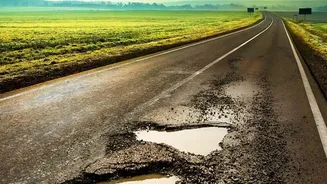
For commuters across India, navigating city streets after a heavy monsoon is a test of patience and skill. Intense rainfall consistently washes away road surfaces, leading to cracks, craters, and widespread waterlogging. This isn't just an inconvenience;
it's a costly and dangerous problem. In 2022 alone, potholes on national highways were linked to over 4,400 accidents and more than 1,800 fatalities. Municipal authorities and the National Highways Authority of India (NHAI) spend crores annually on repairs, which are often temporary fixes that crumble by the next rainy season. This endless cycle of damage and repair creates significant traffic disruption, increases fuel consumption, and places a recurring financial burden on public funds.
What is Self-Healing Asphalt?
Imagine a road that can automatically fix its own micro-cracks before they turn into hazardous potholes. That is the core idea behind self-healing asphalt. This innovative technology isn't a single product but a category of advanced paving materials designed to extend a road's lifespan significantly. There are several methods being explored. One prominent technique involves embedding tiny capsules containing a rejuvenating agent (like oil) into the asphalt mix. When a crack forms, the capsules break open, releasing the agent to fill the gap and re-bind the material. Another method adds fine steel fibres to the asphalt. When cracks appear, an induction heating machine is passed over the surface, causing the fibres to heat up and melt the surrounding bitumen, which then flows to seal the fissures.
The Role of Eco-Friendly Bio-Binders
The headline's mention of "bio-binders" points to an even more sustainable evolution of this technology. Traditional asphalt uses bitumen, a petroleum-based product, as the glue that holds stones and gravel together. Bio-binders are renewable, plant-based substances that can partially or fully replace bitumen. These are often derived from agricultural or forestry by-products like vegetable oils, corn husks, or lignin. Using bio-binders not only reduces reliance on fossil fuels but can also lower the carbon footprint of road construction, as the plant materials sequester carbon during their growth. Some formulations enhance flexibility, making the road more resistant to cracking from temperature changes—a key advantage in India's varied climate.
Is This Technology Coming to India?
Yes, the push for smarter, more durable roads is already underway in India. The National Highways Authority of India (NHAI) has confirmed it is exploring self-healing technologies as a long-term solution to the pothole problem. Research institutions are also playing a crucial role. Institutes like IIT-Madras and the Central Road Research Institute (CRRI) are actively experimenting with polymer-modified and bio-bitumen variants tailored for Indian conditions, which include heavy traffic loads and extreme weather. In fact, a pilot project led by an Indian-origin professor demonstrated a successful self-repairing road in a village in Karnataka several years ago, proving the concept's viability in a local context.
The Road Ahead: Challenges and Potential
While the promise is immense, widespread adoption of self-healing asphalt faces hurdles. The primary challenge is cost. The initial expense of manufacturing asphalt with special capsules or steel fibres can be higher than conventional methods. However, supporters argue this is offset by a much longer lifespan and dramatically reduced maintenance costs over time, potentially doubling the road's functional life. Convincing municipal bodies and contractors to invest more upfront for long-term savings requires a shift in mindset. Furthermore, the technology needs to be scaled up from labs and pilot projects to mass production. As research continues and costs potentially decrease, self-healing roads could move from an innovative concept to a standard feature of India's infrastructure.