


Your Viewing Schedule
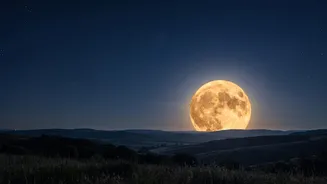
The 2026 Harvest Moon will be visible across India, reaching its peak fullness on Saturday, September 26, at approximately 10:19 PM IST. While this is the moment of maximum illumination, the moon will appear impressively full on the evenings of both September 26 and
September 27. The best time to watch is just after sunset as the moon begins to climb above the eastern horizon. Its appearance low in the sky often gives it a warm, golden-orange hue, making for a spectacular sight. Check a local almanac or astronomy app for the precise moonrise time in your city to catch the show right from the start.
More Than Just a Full Moon
What makes the Harvest Moon special isn't just its name; it's the science behind it. This is the full moon that occurs closest to the autumnal equinox, which in 2026 falls on September 22. Around this time of year, the angle of the moon's orbit relative to the horizon is at its smallest. The result? For several nights in a row, the moon rises only a short while after sunset—around 20 to 30 minutes later each night, instead of the usual 50. This phenomenon historically gave farmers extra hours of bright moonlight to bring in their crops, which is how the moon earned its name.
A Sky-High Family Activity
The Harvest Moon offers a perfect excuse to gather the family for a memorable evening. Plan a simple picnic on your terrace or in a nearby park and watch the moon rise together. It’s a wonderful opportunity for storytelling—you can share the folklore behind the moon's name or even invent your own stories. For students, this is a fantastic real-world astronomy lesson. It’s a chance to observe a key celestial event and understand the relationship between the Earth, Sun, and Moon in a tangible way. It demonstrates how astronomical cycles have influenced human culture and agriculture for centuries.
Connections to Indian Traditions
In India, full moon nights, or Purnimas, hold deep cultural significance. The September 26 full moon coincides with Bhadrapad Purnima, an auspicious day in the Hindu calendar. While the Harvest Moon is a global name rooted in agriculture, the spirit of celebrating the bounty of the season resonates deeply here. Many Indian traditions celebrate the full moon closest to the autumn harvest. The following full moon, Sharad Purnima on October 25, is famous for the practice of preparing kheer and leaving it under the moonlight, which is believed to absorb healing and divine properties. The Harvest Moon is a perfect prelude to this season of celestial reverence.
Tips for Stargazers
For the best viewing experience, try to find a spot away from bright city lights, which can wash out the moon's glow. An open field, a quiet park, or a high vantage point with an unobstructed view of the eastern horizon is ideal. Give your eyes about 15-20 minutes to adjust to the darkness. While the moon is beautiful to the naked eye, a simple pair of binoculars can reveal stunning details on its surface. As an added bonus for 2026, the planet Saturn will be visible near the moon shortly after it rises, offering a chance to spot two celestial wonders at once.