



A Sweet Discovery in a Surprising Place
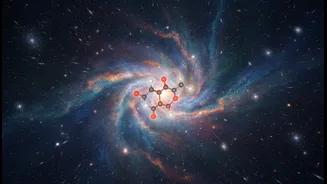
Scientists have detected erythrulose, a four-carbon sugar, in a massive cloud of gas and dust approximately 27,000 light-years away. This molecular cloud, known as G+0.693-0.027, is located near the supermassive black hole at the heart of the Milky Way.
On Earth, erythrulose is a simple sugar found naturally in fruits like raspberries. While other sugar-like molecules have been found in meteorites and even on asteroids, this marks the first time a “true” sugar—a carbohydrate with at least three carbon atoms—has been conclusively identified in the interstellar medium, the raw material from which new stars and planets are born.
How Do You Find Sugar in Space?
Detecting a specific molecule across thousands of light-years is a monumental task. An international team led by researchers from Spain’s Centre for Astrobiology accomplished this feat using two powerful radio telescopes. Every molecule, as it rotates and vibrates in space, emits a faint radio signal at a unique set of frequencies—a distinct chemical “fingerprint.” The team aimed their telescopes at the galactic centre, collecting these faint signals. After painstaking analysis, they found 12 specific signals that perfectly matched the laboratory signature of erythrulose, confirming its presence in the cosmic dust cloud.
More Than Just a Grain of Sugar
Finding this particular sugar is a huge step for astrobiology. Sugars are fundamental to life as we know it; they form the structural backbone of RNA and DNA, the molecules that carry genetic instructions. Erythrulose is considered a key prebiotic molecule because it can participate in reactions that form ribonucleotides, the building blocks of RNA. The discovery supports a popular theory about the origin of life known as the “RNA world” hypothesis, which suggests that RNA, not DNA, was the first genetic material. The presence of its potential precursors in deep space suggests the universe is naturally capable of producing the foundational components of biology.
The Building Blocks of Life, Delivered?
One of the great puzzles in understanding life’s origins is how Earth acquired its initial stock of complex organic molecules. Lab experiments suggest that forming sugars under the conditions of early Earth would have been very difficult. This discovery provides a compelling alternative: what if the ingredients weren’t made on Earth, but delivered? The theory is that these molecules form in interstellar clouds, get swept up into newly forming solar systems, and are then delivered to young, rocky planets via comet and asteroid impacts. Finding erythrulose freely floating in a stellar nursery strongly suggests that the chemical starting materials for life are not rare, but a common feature of the galaxy.
What's Next for Cosmic Chemistry?
The finding also presented a new puzzle. The team found a surprising abundance of the four-carbon erythrulose but no trace of simpler, three-carbon sugars they were also looking for. This challenges the idea that complex molecules form one carbon atom at a time. Instead, it hints that erythrulose may form from the combination of two, more common two-carbon molecules. The next step for scientists is to search for even more complex sugars, like the five-carbon ribose that forms the spine of RNA. Another major question is whether these space sugars show a preference for a specific “handedness,” or chirality—a key feature of life on Earth, where all sugars are “right-handed.” This discovery has opened a new frontier in our quest to understand if we are, in fact, not alone.