



Your Eyes are a Time Machine
It sounds like science fiction, but it's a fundamental truth of our universe. Light, while incredibly fast, doesn't travel instantaneously. It moves at a staggering speed of nearly 3,00,000 kilometres per second. When a star is incredibly far away, its
light takes a significant amount of time to cross the vast emptiness of space and reach our eyes. This travel time is measured in 'light-years'—the distance light travels in one year. So, when you gaze at a star that is 1,000 light-years away, you are seeing it as it was 1,000 years ago. The photons—particles of light—that are hitting your retina began their journey a millennium in the past. The star you see might have changed dramatically since then, or it could even have died in a supernova explosion. You are, quite literally, looking at a ghost of the past.
Starlight from the Vedic Period
Let’s make this real. Look for the constellation Orion, one of the most recognisable patterns in the night sky, often visible in India during the winter months. One of its brightest stars is Betelgeuse, the reddish giant that forms Orion’s shoulder. Betelgeuse is approximately 640 light-years away. This means the light we see from it tonight left the star around the year 1384 CE. At that time in India, the Tughlaq dynasty was ruling the Delhi Sultanate. The world was a completely different place. Now consider Rigel, the bright blue-white star that forms Orion's left foot. It's about 860 light-years distant. The light from Rigel began its journey to your eyes around the 12th century, a time when the Chola dynasty was a dominant power in Southern India. Every star tells a different historical story.
Messages from Before Recorded History
The further we look, the deeper into history we travel. Take Deneb, the brightest star in the constellation Cygnus (the Swan). Astronomers estimate it to be around 2,600 light-years away. When the light we see from Deneb tonight started its journey, much of India was in the late Vedic period. The Mahajanapadas, the sixteen great kingdoms of ancient India, were taking shape. The philosophical foundations of Buddhism and Jainism were being laid. That faint point of light in our sky is a direct link to that foundational era of our history. Even more profound is looking at objects beyond individual stars. The Orion Nebula, the fuzzy patch in Orion’s 'sword', is a stellar nursery where new stars are being born. It's about 1,344 light-years away. The light from this cosmic cradle connects us to a time when the Gupta Empire was nearing its golden age. We are witnessing the birth of stars as it happened over a millennium ago.
How to See This History Yourself
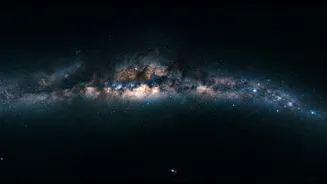
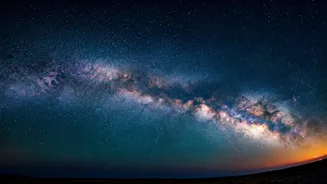
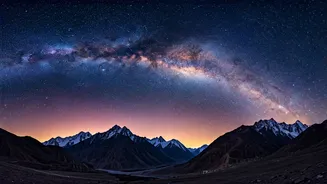
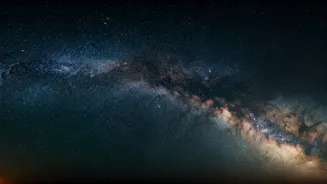
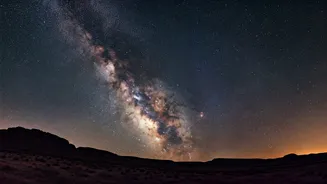
You don't need a powerful telescope to be a time traveller. The first step is to get away from city lights. Find a spot with a dark, clear sky. In India, places like the Spiti Valley in Himachal Pradesh, the Rann of Kutch in Gujarat, or high-altitude spots in Ladakh offer breathtaking views of the Milky Way. Even from a suburban area, you can use stargazing apps on your smartphone like Stellarium or SkyView. These apps use your phone's GPS and compass to identify the stars, planets, and constellations you're pointing at. They can tell you the name of a star and its distance, instantly connecting you to its ancient past. Look for Polaris, the North Star. Its light is about 433 years old, meaning it left the star when Akbar was ruling the Mughal Empire. Every star becomes a history lesson.