



The Invisible Glue of the Cosmos
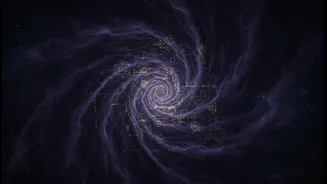
Before diving into hidden dimensions, it's crucial to understand why we need dark matter in the first place. When astronomers look at galaxies, they see them spinning so fast that, based on the visible matter alone, they should fly apart. There simply
isn't enough gravitational pull from the stars and gas we can see. Dark matter is the name given to the invisible 'stuff' that provides this extra gravity, acting as a cosmic glue holding galaxies together. It makes up about 27% of the universe, yet we can't see it or touch it, and no particle in our current Standard Model of physics fits the description. This has left scientists searching for a new kind of physics.
Introducing a Fifth Dimension
The idea of extra dimensions isn't new; it has been a part of theoretical physics for a century, from Kaluza-Klein theory to modern string theory. These theories propose that our reality might have more than the three spatial dimensions (length, width, height) and one time dimension we experience. A recent theory from scientists at the University of Sheffield takes this idea a step further. It suggests that dark matter particles—and a new force-carrying particle called a 'dark photon'—exist within a hidden fifth dimension. The specific geometry of this extra dimension is key to the entire concept.
A Natural 'Resonance'
So how does this help? The new theory proposes that the shape of this fifth dimension naturally causes the masses of dark matter particles to align in a specific arrangement. This creates a phenomenon called 'dark matter resonance', likened to how a musical instrument vibrates intensely when it hits the perfect note. This resonance could explain a long-standing puzzle: why dark matter seems to have interacted strongly in the early universe but is almost inert and undetectable today. Previous models could achieve this but required physicists to artificially 'fine-tune' the numbers. This new theory suggests the tuning isn't a coincidence but a natural consequence of the hidden dimension's geometry.
For Physics Readers: A New Perspective
For those who follow the frontiers of science, this theory offers a beautiful new narrative. It connects two of the most speculative but exciting ideas in physics—dark matter and extra dimensions—into one elegant framework. It shifts the conversation from just hunting for a single new particle to considering a whole new 'dark sector' of reality with its own rules, geometry, and forces. Reading about this theory is like getting a glimpse of the universe's underlying mathematical symphony, where the geometry of hidden space could be the composer of the cosmic structure we observe. It’s a compelling reminder that the universe could be far stranger and more interconnected than we imagine.
For Students: Science in Action
For students of physics and science, this theory is a powerful lesson that the field is far from finished. It demonstrates how scientists build upon existing ideas, like Warped Extra Dimension (WED) models, to tackle unsolved problems like the nature of dark matter and the hierarchy problem (why gravity is so weak). It's a perfect case study in theoretical model-building, showing how a single, elegant idea—that resonance is natural, not forced—can resolve nagging inconsistencies. It underscores that major breakthroughs often come from asking bold questions and imagining realities beyond what we can directly observe, inspiring a new generation to tackle the next big unknowns.
For Space Enthusiasts: A Richer Cosmos
Space enthusiasts are often captivated by the vastness and beauty of the cosmos. This theory adds another layer of wonder. It suggests that when we look up at the night sky, we are only seeing a sliver of the full reality. The universe isn't just the 4D spacetime we perceive; it could be a 'brane' floating in a higher-dimensional space. The idea that dark matter's gravitational pull 'leaks' from another dimension reframes our understanding of the cosmos. It implies that the search for dark matter isn't just about finding new particles here, but potentially about finding portals or gateways to a hidden reality. It makes the universe even more mysterious and exciting to explore.