





Earth's Cautionary Twin
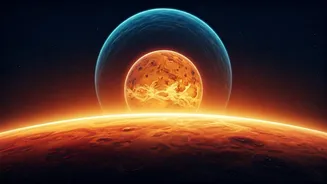
Venus and Earth started as planetary siblings, similar in size, mass, and composition. Scientists believe Venus may have once hosted liquid water oceans and possibly habitable surface temperatures for billions of years. So, what went wrong? The leading
theory points to a runaway greenhouse effect. Being closer to the Sun, Venus's early oceans began to evaporate. Water vapour, a potent greenhouse gas, trapped more heat, causing more water to evaporate. This vicious cycle eventually boiled the oceans away, leaving behind a crushing atmosphere of carbon dioxide, ninety times thicker than Earth's, and a surface hot enough to melt lead.
Enter Shukrayaan-1
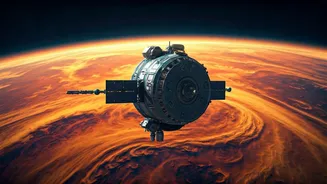
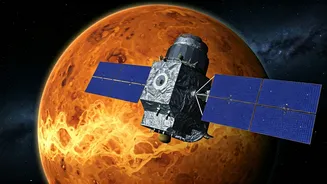
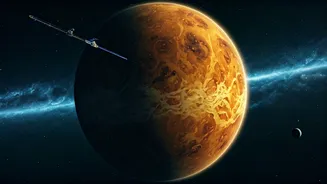
To piece together this climate catastrophe, the Indian Space Research Organisation (ISRO) is planning its first-ever mission to Venus: Shukrayaan-1. The Venus Orbiter Mission (VOM) received formal approval from the Indian government in September 2024 and is slated for a potential launch in March 2028. The mission's primary goal is to study Venus from orbit, investigating its mysterious surface, which is hidden beneath a dense layer of sulphuric acid clouds, and analyzing its complex atmosphere. It represents a major step in India's planetary exploration programme, following successful missions to the Moon and Mars.
A Detective's Toolkit
Shukrayaan-1 will be equipped with a suite of scientific instruments designed to answer long-standing questions about the planet. A key instrument is a high-resolution Synthetic Aperture Radar (SAR), which can peer through the dense cloud cover to map the planet's surface in detail. This will help scientists look for evidence of past geological activity, like volcanoes, which may have contributed to the runaway greenhouse effect. Other instruments, including spectrometers, will study the atmospheric composition, its dynamics, and how it interacts with the solar wind, which will help explain how Venus lost its water.
Lessons for a Changing Earth
Studying Venus isn't just about understanding another planet; it's about understanding our own. While Earth is not in immediate danger of becoming a Venusian-style hothouse, Venus provides a natural laboratory for an extreme climate change scenario. By understanding the tipping points that led to Venus’s dramatic transformation, scientists can vastly improve the climate models they use to predict Earth's future. The data from Shukrayaan-1 will test our knowledge of how greenhouse gases behave on a planetary scale and provide a crucial stress test for our understanding of atmospheric physics. It will help answer the ultimate question: what makes a planet habitable, and how fragile is that habitability?