





The Promise and Peril of Bag Tracking
The ability to track your checked luggage on a smartphone app was hailed as a revolution in passenger peace of mind. In theory, it transforms the bag's journey from a complete black box into a transparent, step-by-step process. People are accustomed to real-time
updates for everything from food delivery to online shopping, and they expect the same from airlines. The technology is largely there—a mix of manual barcode scanning and, increasingly, automated RFID (Radio Frequency Identification) readers that track bags from check-in to the aircraft. Yet, for many travellers, these apps introduce a new kind of stress. The status updates, meant to be reassuring, are often a source of confusion and panic. Does 'in transit' mean it's on the plane or just somewhere in the airport? Is 'delivered' the same as 'on the carousel'? This digital Tower of Babel across different airline apps is a significant flaw in an otherwise impressive system.
Decoding a Confusing Digital Language
The core of the problem is a lack of standardization. Each airline seems to have its own dictionary for a bag's journey. One airline's 'Loaded' might be another's 'Onboard'. When you're making a tight connection, the distinction between 'Transfer' and 'Connecting' is more than just semantic—it's the difference between relief and dread. A status of 'Arrived' can be particularly misleading. It often means the bag has landed at the destination airport, but it could still be in the aircraft's hold, on a baggage cart, or waiting to be sorted, long before it reaches the claim area. This inconsistency forces passengers to become linguists, trying to interpret vague terms. The International Air Transport Association (IATA) has a standard, Resolution 753, which mandates tracking at four key points: check-in, loading onto the aircraft, delivery to a transfer area, and return to the passenger. While this ensures bags are tracked, it doesn't dictate the exact customer-facing language, leaving passengers in a lurch.
How the Technology Actually Works
To understand why standardization is possible, it helps to know how tracking works. Traditionally, bags were tracked with barcodes, which required a manual scan at each checkpoint. This method was prone to human error—a missed scan could make a bag disappear from the system until it was found again. Today, many airlines are adopting RFID technology. A small chip in the luggage tag emits radio waves, allowing automated readers placed throughout the airport—at check-in, on conveyor belts, and near the aircraft—to track the bag's location in real-time without needing a direct line of sight. This data is fed into the airline’s system, which then pushes updates to your app. Since the underlying tracking points are becoming more automated and standardized due to IATA's push for better data exchange, the main challenge isn't technological. The data exists; the problem is how it's presented to the customer.
The High Cost of Passenger Anxiety
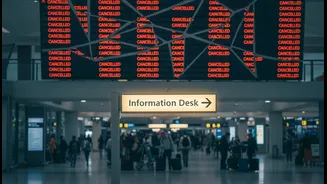
This confusion isn't just a minor inconvenience; it has real consequences for both passengers and airlines. For travellers, ambiguous status updates create unnecessary stress during what is already a tense part of the journey. It can lead to crowding near airline service desks and frantic calls to customer support, as passengers seek clarification that the app should have provided. For airlines, this ambiguity undermines the very purpose of the tracking feature. Instead of building confidence, it can erode trust. Every phone call to a service agent to ask, "Where is my bag, really?" is an operational cost that could be avoided with clearer communication. A simple, industry-wide glossary of terms—'Loaded on aircraft,' 'Unloaded at destination,' 'On baggage carousel'—would eliminate guesswork and reduce the 'anxiety tax' currently paid by passengers.
A Simple Plea for a Common Language
The path forward is clear: the aviation industry needs to agree on a standardized set of plain-language terms for baggage status updates. IATA and other industry bodies are already working on standardizing the back-end data exchange between airports and airlines with initiatives like Baggage Information eXchange (BIX). The next logical step is to extend that standardization to the passenger-facing app. This isn't about reinventing the wheel. It's about agreeing that 'Loaded' means the bag is physically on the plane you're about to board, and 'At Carousel' means it's on its final leg of the journey to your hand. Such a move would be a huge win for customer experience, turning a point of friction into a moment of genuine reassurance. It would empower passengers with information they can actually trust and allow the technology to deliver on its original promise of a stress-free baggage experience.