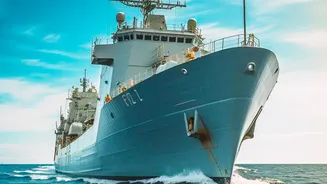




The vast majority of global trade travels by sea, a complex dance of colossal vessels navigating crowded ports and unpredictable oceans. Now, a groundbreaking innovation from IIT Madras could redefine maritime safety and efficiency for decades to come.
Introducing SeaNav: A Digital Ocean
Researchers at the Indian Institute of Technology Madras have developed 'SeaNav', a state-of-the-art testing platform for autonomous ships. Think of it as a highly advanced simulator—a digital twin of the real world—where the sophisticated algorithms that guide self-driving vessels can be tested, validated, and perfected in a safe and controlled environment. Developed by the Department of Ocean Engineering, this platform addresses one of the biggest hurdles in maritime innovation: the immense risk and cost associated with testing unproven navigation systems on the open water. By creating a virtual sandbox, SeaNav allows developers to push the limits of autonomous technology without endangering crew, cargo, or the marine ecosystem.
The Challenge of Real-World Testing
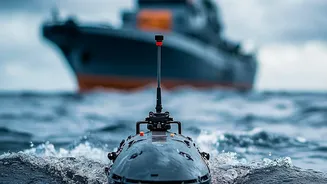
Why is a simulator so crucial? Unlike autonomous cars, which face their own set of challenges, self-driving ships must contend with a uniquely harsh and dynamic environment. Real-world variables include chaotic weather, unpredictable currents, congested shipping lanes, and complex manoeuvres required for docking in busy ports. Testing a new collision avoidance algorithm in these conditions is not only expensive but potentially catastrophic. A single error could lead to devastating accidents. Furthermore, these systems rely on a suite of sensors like radar, LiDAR, and cameras, all of which can be affected by fog, rain, or equipment noise. SeaNav allows for the repeated testing of these 'what-if' scenarios, from sensor failures to sudden storms, ensuring the AI can handle the worst before it ever leaves the harbour.
Inside the Virtual Environment
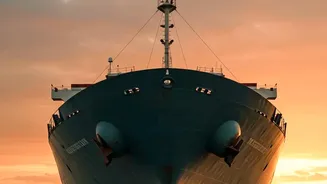
SeaNav is more than just a simple computer program. Built on the Unity3D engine, it creates a high-fidelity digital twin that accurately replicates everything from ocean waves to the specific movements of different vessel types. The system has been calibrated using a benchmark tanker vessel over 300 metres in length, ensuring its simulations closely mirror real-world commercial shipping operations. It incorporates a multi-sensor fusion framework, mimicking how a real ship would combine inputs to 'see' its surroundings. A key feature is its ability to simulate multi-vessel interactions, allowing developers to train AI on how to navigate crowded waterways and avoid other ships—a critical skill for safe deployment.
Powering India's Maritime Ambitions
This innovation arrives at a pivotal moment for India. SeaNav directly supports the goals of national initiatives like the 'Sagarmala Programme' and the 'Maritime India Vision 2030'. These ambitious government frameworks aim to modernize India's ports, improve logistics, and foster technological innovation across the maritime sector. By providing a crucial piece of testing infrastructure, IIT Madras is helping to position India as a potential leader in the burgeoning field of maritime autonomy. The platform can be used to enhance safety and develop smarter navigation strategies at major Indian ports like Chennai, Mumbai, and Visakhapatnam, directly contributing to the vision of creating worldclass maritime hubs.
From Simulation to the High Seas
While fully autonomous, crewless ships are still on the horizon, SeaNav is a critical stepping stone. The platform is not just for testing pure AI; it also features a Virtual Reality (VR) interface. Using headsets, human operators and maritime professionals can train for emergency responses, practise difficult port approaches, and familiarise themselves with AIassisted navigation systems in a completely immersive setting. This dualuse capability—training both the machine and the human—bridges the gap between current operations and a future where autonomous systems play a much larger role. The platform's capabilities also extend to coastal surveillance, searchandrescue operations, and maritime defence, showcasing its versatility beyond commercial shipping.