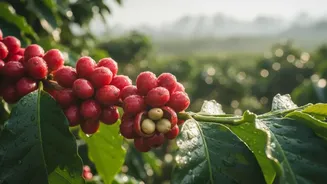







The Birthplace: Classic Chikmagalur
Every story of Indian coffee begins in Chikmagalur. According to legend, this is where the Sufi saint Baba Budan planted seven smuggled coffee beans from Yemen in the 17th century, kickstarting an entire industry. Nestled in the Western Ghats of Karnataka,
Chikmagalur's high altitudes (1,000–1,500m) and rich volcanic soil create the ideal conditions for cultivating high-quality Arabica. The coffee here is almost entirely shade-grown, often inter-cropped with pepper and cardamom, which subtly influences its final taste. A classic Chikmagalur Arabica is known for its balance and elegance. It typically has a mild, soft acidity with flavour notes of chocolate, nuts, and a gentle hint of citrus or berries. This balanced and smooth profile makes it incredibly versatile, working equally well in a filter brew or as a base for espresso. It received a Geographical Indication (GI) tag in 2019, cementing its status as a unique and protected regional specialty.
The Powerhouse: Comforting Coorg
If Chikmagalur is where Indian coffee was born, Coorg (or Kodagu) is where it grew up. As India's largest coffee-producing district, it accounts for roughly a third of the country's total output. Situated at a slightly lower altitude than Chikmagalur (around 850–1,100m), Coorg coffee is known for being fuller-bodied, rounder, and less acidic. Where a Chikmagalur bean might be described as bright and floral, a Coorg Arabica is more likely to be comforting and robust. The dominant flavour notes are of chocolate, nuts, and warm spices, with a pleasantly strong body and a lingering finish. Like in Chikmagalur, the coffee here is shade-grown, often under a two-tier canopy of trees that enriches the soil and protects the crop. This profile makes it a favourite for traditional South Indian filter coffee and blends that require a solid, dependable base. For those new to single-origin Indian coffees, the approachable and satisfying character of a Coorg roast is often the perfect starting point.
The Changemaker: Vibrant Araku Valley
Araku Valley, located in the Eastern Ghats of Andhra Pradesh, represents the modern face and future of Indian specialty coffee. Its story is as compelling as its flavour. Coffee cultivation was introduced here as part of a tribal development program, empowering local Adivasi communities with a sustainable livelihood. The coffee is grown entirely organically, in iron-rich soil at altitudes of 900 to 1,100 meters, under the natural shade of mango and jackfruit trees. This unique terroir produces a coffee that is distinct from its Karnataka counterparts. Araku Arabica is celebrated for its bright, clean acidity and complex flavour profile, often featuring notes of stone fruit, sweet lime, or mandarin, with a clean, tea-like finish. It has won international acclaim, with some lots scoring over 90 points on the Specialty Coffee Association's scale, placing it among the world's elite coffees. Araku's success proves that ethical, sustainable farming can produce world-class quality.
Defining Indian Coffee Together
So, how do these three regions define specialty Indian coffee? They do it through their diversity. Together, they dismantle the outdated notion that all Indian coffee is heavy, earthy, or best suited for instant blends. Chikmagalur provides the classic, elegant foundation, a taste of coffee history. Coorg offers the bold, comforting, and chocolatey profile that feels both familiar and deeply satisfying. Araku Valley brings a bright, fruity, and modern dimension, showcasing the exciting potential of new terroirs and sustainable practices. Each region's single-origin Arabica tells a different story of its soil, altitude, and cultivation methods. The journey from the floral notes of a high-altitude Chikmagalur to the full-bodied spice of a Coorg brew and the fruity acidity of an Araku roast is a tour of India itself. They prove that Indian specialty coffee isn't one single flavour but a rich and varied landscape waiting to be explored, one cup at a time.