



Beyond the vibrant energy of Lisbon and Porto, the true soul of Portugal whispers from the past along the cobblestone lanes of its countryside. Here, time slows, and history is etched into every stone, doorway, and winding alley.
Óbidos: The Queen's Medieval Town
Walking into Óbidos feels
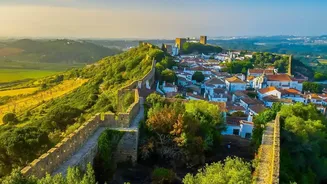
like stepping through a portal to the Middle Ages. For centuries, this village was the personal property of Portugal's queens, a tradition that began in 1210. The entire town is perfectly preserved within its original 14th-century fortified walls. The main street, Rua Direita, is a charmingly narrow path of cobblestones, lined with whitewashed houses adorned with vibrant bougainvillea and splashes of blue and yellow paint. You can walk the entire 2km circuit of the ramparts, offering stunning views over terracotta rooftops and the surrounding countryside. The journey is best paired with a taste of the local cherry liqueur, Ginjinha, often served in a small chocolate cup. The castle at the town's highest point, once a Moorish fort, now operates as a historic hotel, adding to the fairytale atmosphere.
Monsanto: The Village Built Among Boulders
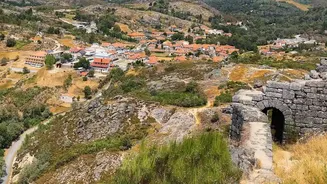
Monsanto is a marvel of human adaptation, a village built in perfect, and almost unbelievable, harmony with nature. Here, houses don't just sit on the land; they are integrated with giant granite boulders that serve as walls, floors, and even roofs. Once voted 'the most Portuguese village in Portugal' in 1938, Monsanto has a history stretching from the Paleolithic era through Roman, Visigoth, and Templar Knight occupations. The narrow, steep streets wind their way up the mountain, with every turn revealing another home squeezed between colossal rocks. The effect is so cinematic that the village was used as a filming location for 'House of the Dragon'. Climbing to the top of the hill rewards you with the ruins of a medieval castle, offering panoramic views that stretch towards the Spanish border.
Piódão: The Schist Nativity Scene
Hidden deep within the Serra do Açor mountains, Piódão appears suddenly, a breathtaking amphitheater of dark, slate-like houses cascading down a steep hillside. Known as one of Portugal's 'schist villages', its buildings are constructed almost entirely from this local stone, creating a monochrome landscape punctuated by the bright blue-painted doors and windows. The village's isolation, accessible only by foot or horseback until the 1970s, has preserved its unique character. With a population of fewer than a hundred residents, wandering its silent, winding lanes feels like exploring a living museum. The main church, with its brilliant white and blue facade, stands in stark contrast to the dark schist, serving as the village's focal point. There isn't much 'to do' in Piódão, and that is precisely the point—the pleasure is in the slow, quiet exploration of a place seemingly untouched by time.
Sortelha: The Unchanged Border Fortress
Sortelha is one of the most beautifully preserved medieval defensive villages in Portugal. Perched at an altitude of 760 meters, its granite houses and streets are still enclosed by a formidable ring of 13th-century walls, guarded by a towering castle. The urban layout has remained virtually unchanged since the Renaissance, offering an authentic glimpse into the past. The village's name is said to derive from the ring-like shape of its rocky escarpments ('sortija' in Castilian). Visitors enter through a Gothic gateway and can explore the battlements, medieval tombs, and a 16th-century pillory. Unlike more touristed spots, Sortelha provides a quiet, immersive experience where you can walk the ancient cobblestone paths and feel the echoes of centuries of border history.