




Your Best First Telescope
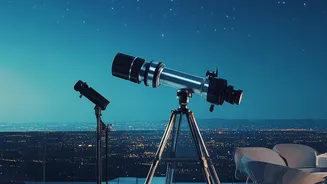
While telescopes are powerful, they can be complicated and have a very narrow field of view, making it hard for beginners to find anything. Binoculars, on the other hand, are intuitive, portable, and offer a wide view of the sky that makes navigating
between stars much easier. A standard pair, such as 7x50 or 10x50, is more than enough to reveal wonders invisible to the naked eye. The first number refers to magnification (7x or 10x) and the second is the diameter of the lenses in millimeters; larger lenses gather more light, making faint objects brighter. Binoculars are perfect for scanning the Milky Way and getting acquainted with the cosmic neighbourhood.
Preparing for the Night
Before you head out, a little preparation goes a long way. Dress in warm layers, as you'll get colder than you expect just standing or sitting still. Find a viewing spot away from the glare of streetlights and house lights; even a park or a backyard shielded by a building can make a big difference. Once you're outside, give your eyes at least 15-20 minutes to fully adapt to the darkness. This will dramatically increase your ability to see faint objects. Finally, find a comfortable way to observe. A reclining garden chair helps prevent neck strain and also helps you hold the binoculars steadier.
Hunting a Galaxy: Andromeda (M31)
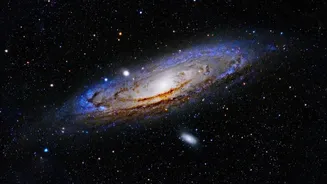
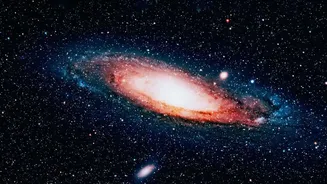
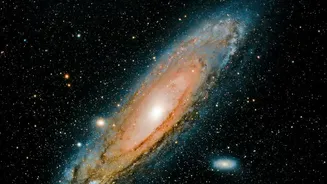
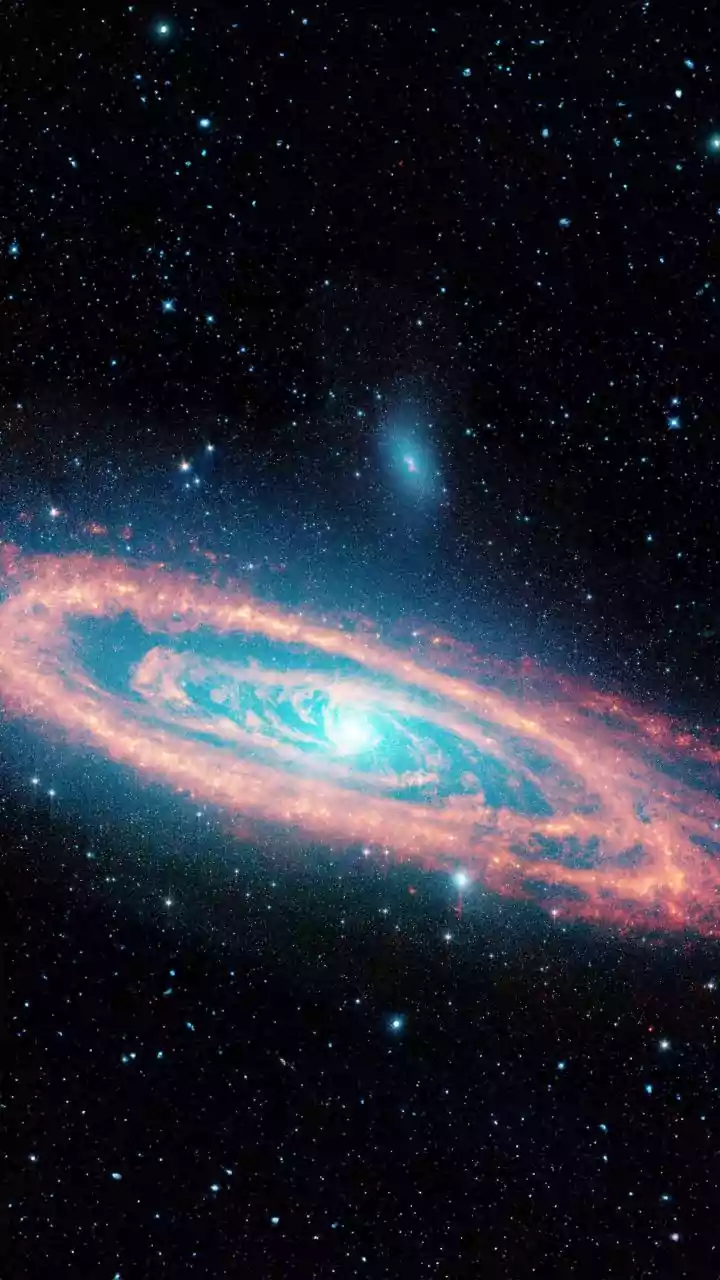
The Andromeda Galaxy is the most distant object you can see with the unaided eye, but it truly comes to life in binoculars. Located 2.5 million light-years away, it will appear as a faint, elongated smudge of light. To find it, first locate the W-shaped constellation of Cassiopeia, which is high in the northeastern sky on autumn evenings. The right-hand 'V' of the 'W' acts like an arrow. Follow that arrow down and across the sky for about three times the width of Cassiopeia itself, and slowly scan the area. Another method is to start from the Great Square of Pegasus, find the chain of stars that form the constellation Andromeda, and hop two stars over from the corner of the square. Through your binoculars, you'll see a distinct, ghostly oval—the core of a galaxy containing one trillion stars.
A Splash of Colour: Albireo
Double stars are pairs of stars that appear close together. One of the most beautiful is Albireo, which marks the head of the swan in the constellation Cygnus. Cygnus is easy to spot as a large cross shape, often called the Northern Cross, which stands upright in the western sky during early autumn evenings. Albireo is the star at the bottom of the cross. To the naked eye, it looks like a single star, but even a basic pair of binoculars held steady will split it into two. What makes it spectacular is the colour contrast: a brilliant golden star next to a dimmer, sapphire-blue companion. This stunning celestial jewel is a favourite for stargazers of all levels and remains a great sight even from light-polluted areas.
An Ancient Eye Test: Mizar and Alcor
For another easy-to-find double, look to the Big Dipper. Find the bend in the Dipper's handle; this is the star Mizar. If you have good eyesight, you might notice a fainter star right next to it, named Alcor. This pair is famously known as the "horse and rider," and spotting Alcor with the naked eye was historically used as a vision test. Through binoculars, the pair is incredibly easy to separate. While they look like a simple pair, this system is far more complex. Mizar itself is a double star when seen through a telescope, and astronomers have discovered that the Mizar and Alcor system actually consists of six stars all gravitationally bound together. For you, it’s a simple, satisfying target that connects you to centuries of stargazing history.
One More Autumn Jewel: The Pleiades
As the night deepens, look to the east for a tiny, shimmering cluster of stars rising. This is the Pleiades (M45), also known as the Seven Sisters. To the naked eye, it looks like a small, hazy dipper, but binoculars transform it into a breathtaking spray of dozens of glittering blue-white stars. The cluster is one of the closest to Earth and is best viewed in autumn and winter. Its wide expanse makes it a perfect target for binoculars, often looking more impressive through them than through a high-powered telescope because you can see the whole cluster at once. It’s a truly magnificent sight that perfectly illustrates the power of the simple optics in your hands.