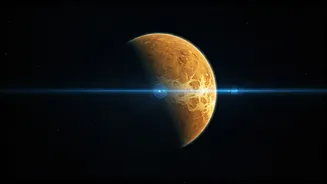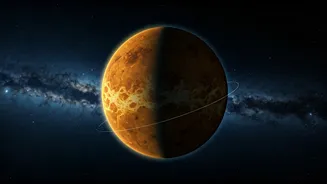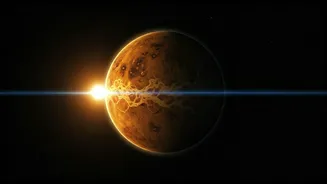



A Day Longer Than a Year?
It’s a fact that bends the mind. Here on Earth, our system is simple: the planet spins once on its axis every 24 hours (a day) and completes one orbit around the Sun every 365 days (a year). On Venus, this relationship is flipped on its head. It takes
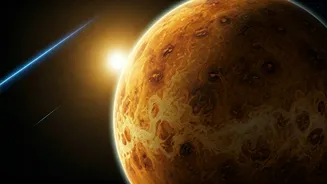
Venus about 225 Earth days to complete a full orbit around the Sun, making its year shorter than ours. However, it takes the planet a staggering 243 Earth days to complete a single rotation on its axis. This means a Venusian 'sidereal day'—the time it takes to spin once relative to the distant stars—is longer than a Venusian year. You could celebrate your first birthday on Venus before the planet has even finished its first 'day'.
The Backwards Planet
The strangeness doesn't stop there. Venus also spins backwards. While Earth and most other planets in our solar system rotate counter-clockwise on their axis, Venus has what's known as a retrograde rotation—it spins clockwise. If you could stand on the surface of Venus (and survive its crushing pressure and scorching heat), you would see the Sun rise in the west and set in the east. This backward, leisurely spin is a fundamental reason why its day is so incredibly long. The combination of its orbital direction and its opposite, slow spin creates a unique and disorienting celestial rhythm unlike anything we experience on Earth.
Why the Slow, Strange Spin?
Scientists don't have a single definitive answer, but there are compelling theories. The leading hypothesis suggests a cataclysmic event deep in Venus's past. Early in the solar system's history, a massive asteroid or planet-sized object may have collided with Venus, disrupting its original rotation and effectively flipping it upside down or slowing it to a near-standstill. Over billions of years, this altered spin settled into its current slow, retrograde state. Another theory points to Venus's incredibly thick atmosphere. This dense blanket of gas is so heavy that it creates powerful atmospheric tides. The Sun's gravity pulls on this thick atmosphere, creating a drag that has acted as a brake on the planet's rotation for aeons, slowing it down to its current crawl.
What Would a Sunrise Feel Like?
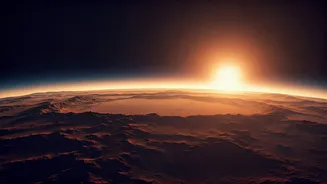
While a single spin takes 243 Earth days, a 'solar day' on Venus—the time from one sunrise to the next—is actually shorter. Because the planet is orbiting the Sun while it slowly spins backwards, the sun appears to complete its journey across the sky in about 117 Earth days. So, if you were to watch a sunrise on Venus, you'd have to wait nearly four Earth months for the next one. This extremely long period of daylight followed by an equally long night has profound effects on the planet. The surface bakes under the Sun for months at a time, then plunges into a long, dark 'night,' although the thick atmosphere traps so much heat that the temperature barely drops.
A Recipe for a Hellish World
This bizarre rotation is not just a quirky fact; it’s a key ingredient in making Venus the inhospitable world it is. The planet's thick, carbon-dioxide-rich atmosphere and slow spin work together to create a runaway greenhouse effect. The long solar days allow the surface to absorb an immense amount of solar energy, while the dense clouds trap that heat with brutal efficiency. There are no fast-spinning jet streams or rapid day-night cycles to distribute the heat. As a result, the surface temperature on Venus is a constant, blistering 465°C, hot enough to melt lead. It’s a powerful reminder of how a planet’s rotation, atmosphere, and position in the solar system are all intricately linked in creating its environment.