


Worlds of Fire and Wind
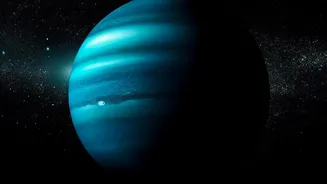
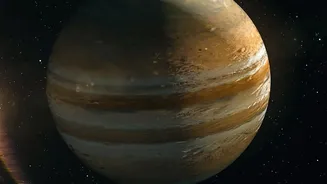
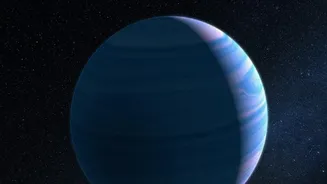
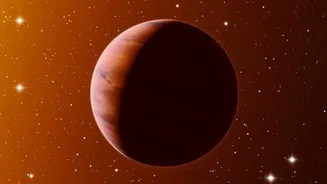
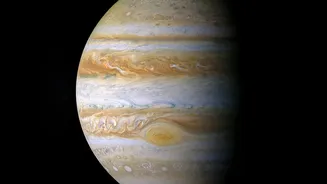
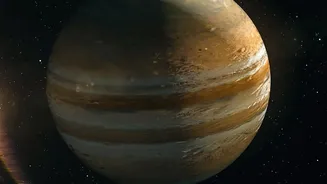
The planets at the center of these discoveries are known as 'hot Jupiters'. These are gas giants similar in size to our own Jupiter but orbiting incredibly close to their parent stars—much closer than Mercury orbits our Sun. This extreme proximity means
they are tidally locked, with one side perpetually facing the star's blistering heat and the other shrouded in permanent darkness. This creates an enormous temperature difference, sometimes by hundreds of degrees, which is the engine for some of the most violent weather imaginable. These planets, like WASP-127b, are often described as 'puffy' because their intense heat causes their atmospheres to inflate, making them large but surprisingly low in density.
How to Clock a Storm from Light-Years Away
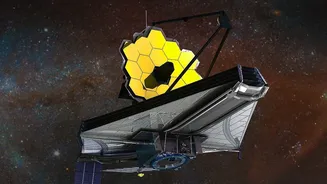
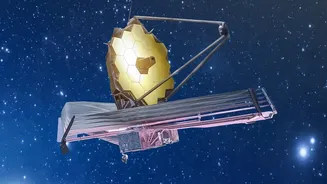
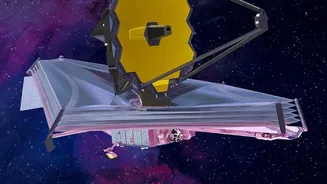
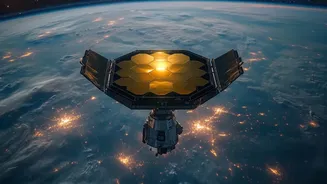
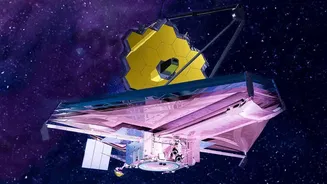
You can't place a weather station on a planet 500 light-years away, so how do astronomers measure these incredible winds? The answer lies in the light. Using powerful infrared observatories like the James Webb Space Telescope (JWST) and the Very Large Telescope (VLT), scientists employ a technique called high-resolution spectroscopy. As a planet passes in front of its star, a tiny amount of starlight filters through its atmosphere. By analyzing this light, astronomers can detect the chemical fingerprints of molecules like water vapor or carbon monoxide. The key is the Doppler effect: as winds carrying these molecules move toward or away from us, the wavelength of their light signature shifts slightly. This shift allows scientists to calculate the speed of the wind with astonishing precision, creating the first-ever weather maps of alien worlds.
Faster Than the Speed of Sound
The speeds being measured are staggering. On the exoplanet WASP-127b, astronomers have clocked an equatorial jet stream moving at nearly 33,000 kilometres per hour. That's more than 18 times faster than the fastest winds ever recorded in our solar system, which were found on Neptune at around 1,800 km/h. To put it another way, these winds are moving at several kilometres per second, far exceeding the local speed of sound in the planet's hot, hydrogen-rich atmosphere. While the term 'supersonic' is relative to a planet's specific atmospheric conditions, these velocities represent a truly extreme form of atmospheric circulation, dwarfing anything seen on Earth.
A Glimpse into Planetary Physics
Mapping these winds does more than just satisfy our curiosity about extreme weather. It provides a natural laboratory for testing our understanding of atmospheric physics under conditions that don't exist in our solar system. For instance, recent studies have found that on the hottest of these planets, wind speeds are surprisingly lower than expected. Scientists believe this could be the first evidence of magnetic fields on exoplanets, which would interact with the ionized atmosphere and create a 'drag' effect, slowing the winds. By studying how heat is distributed from the dayside to the nightside, and how winds are affected by different factors, we can refine our models of how planets form, migrate, and evolve.
The Future of Exoplanet Weather
The ability to map weather on distant worlds is a revolutionary step in astronomy. Instruments like the JWST are providing unprecedented detail, allowing scientists to create three-dimensional maps of temperature and gas distribution. This isn't just about hot Jupiters; the techniques being perfected today could one day be used to study the atmospheres of smaller, Earth-like planets. Understanding the atmospheric dynamics of other worlds helps us place our own planet in a galactic context. It's a crucial step in the ongoing quest to figure out which planets might be capable of retaining their atmospheres and, just maybe, hosting life.