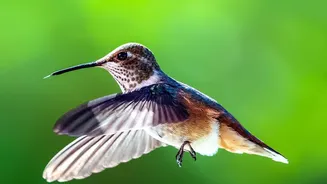





They are jewels of the air, hovering like tiny helicopters and darting with impossible speed. But the hummingbird’s most remarkable talent may be its ability to fly in reverse, a feat of biological engineering that sets it apart.
A Masterclass in Aerial Acrobatics
Most birds are built for
one primary direction of flight: forward. Their wing structure and musculature are optimized to generate lift and thrust in a down-and-back motion, propelling them through the air. Flying backward is, for almost all of them, a physical impossibility. Enter the hummingbird. This tiny avian marvel not only hovers with precision but can also fly sideways, upside down, and, most impressively, backward in a controlled and deliberate way. This isn't an accidental drift caused by wind; it is a purposeful maneuver, essential for its survival and daily life.
The Secret Is in the Shoulder
So, how do they do it? The key lies in their unique anatomy, which is more like an insect's than a typical bird's. Unlike other birds that have rigid shoulders and rely on flexing their wings at the wrist and elbow, hummingbirds have an incredibly flexible ball-and-socket shoulder joint. This allows their wings to rotate nearly 180 degrees. Instead of a simple up-and-down flap, a hummingbird's wing traces a figure-eight pattern, generating lift on both the forward and backward strokes. To fly in reverse, it simply adjusts the angle of its wings to create thrust in the opposite direction, pushing air forward to propel itself backward.
An Evolutionary Masterstroke
This remarkable ability is not just for show; it is a critical evolutionary adaptation tied directly to the hummingbird's diet. As nectarivores, they spend their days flitting from flower to flower. Backward flight allows them to deftly withdraw their long beaks from a blossom after feeding without getting tangled or needing to turn around. This quick and efficient exit strategy saves precious time and energy, allowing them to visit hundreds of flowers a day. It also serves as an excellent defensive maneuver, enabling a rapid escape from predators or a swift retreat from a territorial dispute with another hummingbird.
Are They Truly Alone?
While hummingbirds are the undisputed champions of backward flight, the headline notes they are 'among the few'. Some other species, like warblers, flycatchers, and egrets, can perform short, fluttering backward movements, but these are typically brief, defensive reactions rather than sustained, controlled flight. The hummingbird is unique in its ability to fly backward for significant distances and with complete control, just as it does when moving forward or hovering. This makes it the only bird that has truly mastered six-degree-of-freedom flight, moving up, down, forward, back, and side to side with ease.
The High-Energy Lifestyle
This incredible flight capability comes at a tremendous metabolic cost. To power flight muscles that make up nearly a third of their body weight, a hummingbird's heart can beat up to 1,200 times per minute. They have the fastest metabolism of any vertebrate, meaning they must constantly consume sugary nectar—often eating half their body weight daily—just to stay alive. Interestingly, studies have shown that backward flight is surprisingly efficient, costing about the same amount of energy as forward flight and significantly less than hovering. This efficiency underscores just how perfectly these birds have adapted to their niche, turning a physical impossibility for others into an everyday tool for survival.