

The Moon’s Deep Freeze
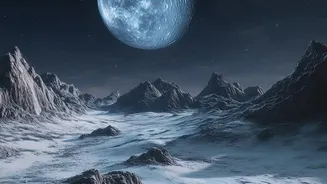
Imagine craters so deep and located so precisely at the pole that their floors have not seen a single ray of sunlight in over a billion years. These are known as Permanently Shadowed Regions, or PSRs. Because the Moon’s axial tilt is a mere 1.5 degrees,
unlike Earth's 23.5, these areas remain in a perpetual, deep freeze, with temperatures plummeting to below -200°C. This makes them perfect cold traps. Water, delivered by comets or created by solar wind interacting with the lunar soil, can become trapped in these frigid pockets as ice, remaining stable for immense geological timescales. Missions have confirmed that these dark, icy patches are concentrated around the poles, turning them into prime real estate for future exploration.
Finding Water from 384,400 KM Away
So, how do you find water in a place you can't see? Scientists use clever remote-sensing techniques. Orbiters like India’s Chandrayaan-1, which made the groundbreaking discovery, and NASA’s Lunar Reconnaissance Orbiter (LRO), use instruments to hunt for water's signature. Spectrometers, like the Moon Mineralogy Mapper (M3) aboard Chandrayaan-1, analyse the light reflected off the lunar surface. Water ice absorbs certain wavelengths of infrared light, creating a unique fingerprint that an orbiter can detect. More recently, data from Chandrayaan-2's advanced radar has peered beneath the surface, identifying dielectric properties consistent with subsurface ice deposits. These methods don't just say "water is here"; they create detailed maps showing the location, concentration, and even potential form of the water, distinguishing it from surrounding rock and soil.
A Treasure Map for Astronauts and Robots
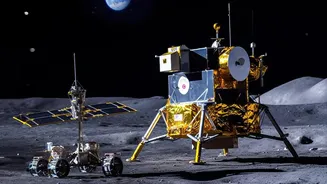
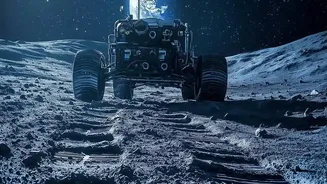
These maps are indispensable for planning future missions. Sending humans or even expensive robots to the Moon is a high-stakes endeavour, and you need to know exactly where to land to get the best return. Knowing the precise coordinates of accessible water ice is like having a treasure map. It allows mission planners to select landing sites with the highest potential for resource extraction. This data dictates the design of rovers, like NASA’s now-cancelled but influential VIPER mission, which was designed to be a ground-truth-seeking mobile laboratory. These rovers would use drills and onboard analysers to confirm the orbiter data, measuring the purity and depth of the ice. This level of detail is critical for determining if a location is viable for establishing a long-term presence.
Living Off the Land: The ISRU Revolution
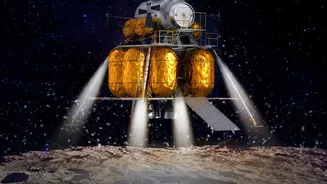
The ultimate goal is In-Situ Resource Utilization, or ISRU—a fancy term for living off the land. Launching anything from Earth is incredibly expensive, so the ability to source materials locally on the Moon is a game-changer. Water is the most valuable of these resources. Astronauts can purify it for drinking and growing food. More critically, through a process called electrolysis, water (H₂O) can be split into its component parts: oxygen and hydrogen. The oxygen can be used for breathable air, and the liquid oxygen and hydrogen can be combined to create powerful, efficient rocket propellant. This means a future lunar base could become a refuelling station for missions venturing further into the solar system, like to Mars.
The Chilling Challenge of Extraction
While the promise is immense, extracting this lunar ice is a formidable engineering challenge. The same extreme cold that preserves the ice makes machinery brittle and operations difficult. The perpetual darkness means solar-powered equipment has limited operational windows, forcing reliance on batteries or other power sources. The lunar dust, or regolith, is another major hazard; it is abrasive, sharp, and electrostatically charged, posing a threat to spacesuits, seals, and mechanical parts. Engineers must design robust systems capable of drilling into what is essentially ice-laced rock in one of the most hostile environments in the solar system. Overcoming these hurdles is the next critical step in turning these mapped resources into a tangible reality for lunar pioneers.