


Einstein's Cosmic Magnifying Glass
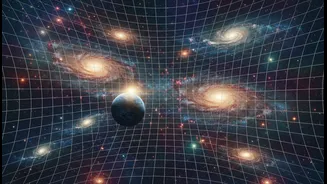
According to Einstein's theory of general relativity, gravity isn't a force but a curvature of space-time caused by mass. Imagine a bowling ball on a trampoline; it creates a dip that a nearby marble will roll into. In the same way, a star's immense gravity warps
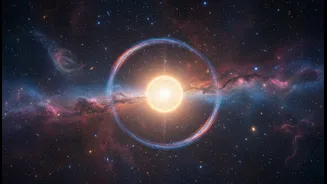
the space around it. When light from a very distant, background star passes near a closer, foreground star, this warped space acts like a lens. It bends and focuses the light, causing the background star to appear temporarily brighter to observers on Earth. This phenomenon is known as gravitational lensing. Sometimes, the alignment is so perfect that the foreground star acts as a natural telescope, magnifying the light from the star behind it. This specific effect is called gravitational microlensing. If the foreground 'lens' star also has a planet orbiting it, the planet's own smaller gravity creates a brief, additional spike in the magnified light—a tell-tale signature that gives away its presence.
A Surprise Find in Old Data
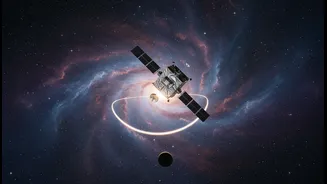
In a remarkable recent discovery, astronomers used this very technique to unearth a new world. The story of the planet, named Gaia23bra b, began in 2023 when the European Space Agency’s Gaia telescope noted a star that was briefly brightening—a classic sign of a microlensing event. However, Gaia's observations were not frequent enough to confirm if a planet was involved. The breakthrough came when scientists combed through archived data from NASA’s Transiting Exoplanet Survey Satellite (TESS). TESS, which happened to be watching the same patch of sky, had captured the event with much more rapid observations. This was a surprise, as TESS wasn't built for this kind of work. It typically finds planets using the 'transit' method, which detects the slight dimming of a star as a planet passes in front of it. The richer TESS data revealed the secondary, planet-sized flicker that Gaia had missed, confirming the existence of a new exoplanet.
Meet Gaia23bra b
The newly confirmed planet, Gaia23bra b, is a behemoth. It is a gas giant about 1.6 times the mass of our own Jupiter. It orbits its host star, an orange dwarf about 80% the size of our Sun, at a distance similar to Jupiter's orbit. What makes this discovery truly stunning is its sheer distance. The planet and its star are located roughly 40,000 light-years from Earth. This is far beyond the normal reach of TESS, which usually finds planets within a radius of about 150 light-years. The discovery of such a distant system was only possible because of the amplifying effect of microlensing, which turned an otherwise invisible system into a detectable signal. It highlights how much information can be hidden within existing astronomical data, waiting for a new perspective or technique to bring it to light.
Why This Technique Is a Game-Changer
While the transit method has been incredibly successful, discovering about 75% of the 6,000 known exoplanets, it has limitations. It is best at finding very large planets that orbit extremely close to their stars. Microlensing complements this by being uniquely sensitive to planets with different characteristics. It can detect planets at vast distances from their stars, in orbits more like those of Jupiter or even Earth in our own solar system. It can also find planets orbiting very dim stars, or even 'rogue' planets that float freely through the galaxy without a host star. Although microlensing events are rare, depending on a chance alignment of stars, they provide a crucial window into planetary systems that would otherwise remain completely invisible to us. This discovery proves that TESS can be a powerful tool for this method, something no one expected when it was launched.