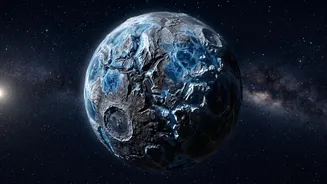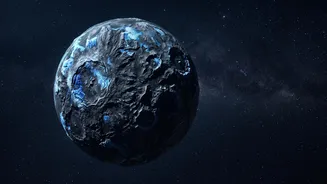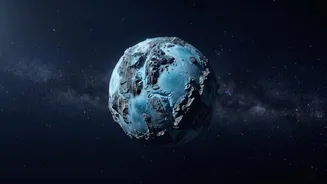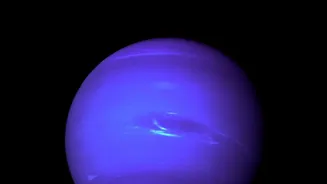


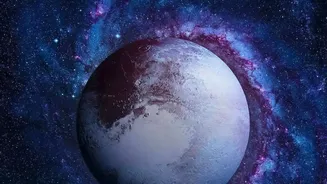
Beyond the familiar glow of the eight planets lies a vast, frozen frontier. The recent discovery of a distant object, named 2026 ED138, is peeling back another layer of mystery from this dark realm, offering new clues about our Solar System.
A New Object in the Kuiper Belt
Astronomers
have confirmed the existence of a new trans-Neptunian object (TNO), a celestial body orbiting our Sun at a distance greater than Neptune. Designated 2026 ED138, this object is a significant find, located in the Kuiper Belt, a doughnut-shaped ring of icy bodies left over from the formation of the Solar System. Initial observations from powerful tools like the Vera C. Rubin Observatory suggest that 2026 ED138 is one of the larger objects discovered in this region, possibly measuring several hundred kilometres in diameter. Its size and brightness make it a candidate for dwarf planet status, joining the ranks of other famous Kuiper Belt residents like Pluto and Eris. These objects are essentially frozen time capsules, holding secrets to our Solar System's 4.6-billion-year history.
The Art of Finding a Ghost
Discovering an object like 2026 ED138 is a monumental task. TNOs are incredibly faint because they are so far from the Sun, reflecting very little light. Astronomers rely on powerful telescopes to repeatedly scan patches of the sky, looking for faint specks of light that move almost imperceptibly against the backdrop of distant stars. The first Kuiper Belt Object after Pluto wasn't found until 1992. Today, advanced survey telescopes automatically compare images taken hours or days apart to flag potential moving objects. Once a candidate is identified, scientists delve into archival data, sometimes searching back decades, to find previous images of the same object. This 'precovery' process allows them to plot the object’s orbit with much greater accuracy, confirming its path and distance.
A Clue in the Search for Planet Nine
One of the most exciting aspects of finding new TNOs is the potential light they shed on the 'Planet Nine' hypothesis. For years, scientists have noticed that the orbits of the most distant objects in the Kuiper Belt are strangely clustered, as if they are being shepherded by the gravity of a massive, unseen planet. This theoretical world, dubbed Planet Nine, is estimated to be about five to ten times the mass of Earth, orbiting far beyond Pluto. Each new discovery like 2026 ED138 provides another crucial data point. By studying its orbit, astronomers can test whether it fits the pattern of gravitational influence predicted by Planet Nine models. The peculiar tilt and shape of these distant orbits are difficult to explain without some large, undiscovered mass in the outer Solar System.
More Than Just Another Rock
Even if Planet Nine remains elusive, objects like 2026 ED138 are scientifically priceless. They are considered planetesimals, the primitive building blocks of planets. In the inner Solar System, these objects collided and merged to form worlds like Earth and Mars. But in the frigid expanse beyond Neptune, this process was halted, leaving a population of well preserved remnants from the Solar System's infancy. Studying the composition, size, and colour of these TNOs gives us a direct window into the conditions of the early solar nebula. For instance, the reddish hue of many KBOs points to specific chemical compositions, and the presence of moons around some dwarf planets suggests a history of violent collisions in the distant past.