





A Surprise on the South Pole
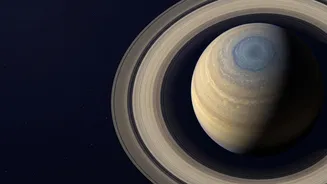
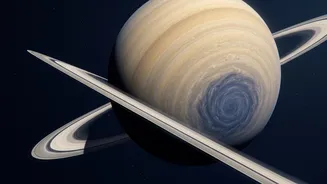
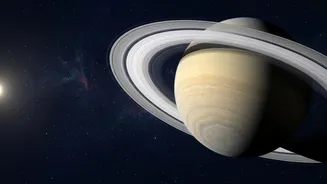
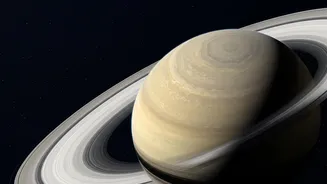
Scientists have announced the discovery of a massive, 10-sided atmospheric pattern swirling around Saturn's south pole. This newfound 'decagon' was identified in recent images from NASA's Hubble Space Telescope, which were taken after the planet's south pole tilted
back into Earth's view after more than a decade in shadow. From 2012 to 2023, Saturn's orientation hid the region, meaning even the Cassini spacecraft, which orbited the planet until 2017, never captured this specific, long-lived polygonal structure. This suggests the decagon is a relatively new phenomenon, giving astronomers a rare opportunity to watch a giant atmospheric feature develop. The discovery, detailed in the journal Science Advances, was led by a team of researchers who pieced together observations dating back to 2023.
Bigger, Younger, and on the Move
While it invites immediate comparison to the famous six-sided hexagon at Saturn's north pole, the southern decagon is a distinctly different beast. For one, it is significantly larger, spanning a width of over 167,000 kilometers. Perhaps the most crucial difference, however, is its movement. While the northern hexagon has remained remarkably stationary for the 40-plus years it has been observed, this new decagon is slowly migrating eastward at a speed of about 10 kilometers per hour. Furthermore, the decagon appears less uniform and stable than its northern counterpart, with some of its ten sides appearing much sharper than others. This has led scientists to believe they are witnessing a structure that is still evolving, rather than a permanent, settled feature.
How to Build a Planetary Polygon
So, how does a gas giant like Saturn create such precise geometric shapes? The answer lies deep within its turbulent atmosphere. These polygons are not solid structures but are visible manifestations of powerful jet streams—rivers of gas flowing at hundreds of kilometers per hour. Scientists believe that when these jet streams encounter certain disturbances, they can create a 'meandering wave' that gets trapped. Under just the right conditions of wind speed, pressure, and temperature, this wave can stabilize into a regular, polygonal shape. The fact that one pole formed a hexagon and the other a decagon tells scientists that the underlying conditions in the two hemispheres are different. The number of sides is directly related to the specific characteristics of the jet stream that contains it.
An Evolving Weather System
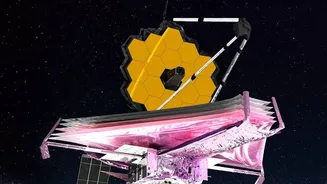
The discovery has shifted our understanding of Saturn. The once-unique hexagon is no longer a complete anomaly; it is now clear that creating giant polygons is something Saturn's atmosphere simply does. Scientists are now working to understand the triggers. One compelling theory points to a large, dark vortex—a separate, high-pressure storm—circling near the decagon. This vortex intensified shortly before the 10-sided pattern became distinct, making it a prime suspect for the initial disturbance that kicked off the wave's formation. However, creating computer simulations that can successfully reproduce both a stable hexagon in the north and an evolving decagon in the south remains a significant challenge for atmospheric physicists. Continued observations from Hubble and the James Webb Space Telescope will be crucial to see if the decagon stabilizes or dissipates over time.