







The Scale of the Unseen Crisis
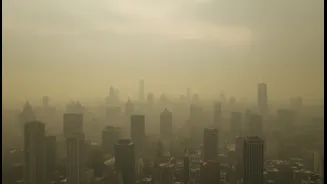
The most sobering lesson from the 2026 report is about what we cannot see. A staggering 85% of India's population, over 1.2 billion people, live outside the range of any real-time air quality monitor. While we focus on the alarming AQI numbers in major
metros, a vast majority of the country is breathing air of an unknown quality. This monitoring gap creates a deep structural inequality in environmental governance. Cities with monitors can access funds and create action plans, but hundreds of smaller towns and industrial belts, which may face even higher pollution, are left invisible and unaddressed. The report makes it clear that what is not measured cannot be managed, and for most of India, the air remains dangerously unmeasured.
Pollution is Not Just a Big City Problem
A persistent myth is that dangerous air pollution is confined to Delhi and other major northern cities. The SoE 2026 report, supplemented by satellite data, dismantles this notion. While Delhi remains the most polluted state, the report highlights that 60% of India's districts breach the national annual air quality standard. The problem is widespread, with emerging hotspots in the Northeast, where states like Assam and Tripura show elevated PM2.5 levels throughout the year. Even in states with better overall air quality, like Maharashtra, dense industrial clusters create local pollution emergencies that exceed national standards. This confirms that air pollution is a truly national crisis, moving beyond the Indo-Gangetic Plain and affecting nearly every corner of the country.
The Staggering Economic Toll
The report underscores a lesson that is increasingly hard to ignore: polluted air is bad for business and the economy. Recent analyses cited alongside the report's release reveal the enormous economic drag caused by air pollution. One report pegged the loss to business revenues in 2024 at a staggering $260 billion, equivalent to a 6% loss to India's GDP. This is more than double the impact estimated just a few years prior, showing the escalating cost. These costs manifest in multiple ways: reduced worker productivity, lower consumer footfall as people stay indoors, and increased healthcare expenses for both households and employers. Major companies have started noting pollution as a factor impacting sales, and economists have warned that air quality is a far bigger threat to India’s economy than global trade issues.
A Call for Structural Solutions
Perhaps the most crucial lesson is the urgent need to shift from temporary, seasonal responses to long-term, structural solutions. The report critiques the cycle of emergency measures during winter, arguing for a year-round, source-level strategy. This means accelerating the transition to clean energy and electric vehicles, enforcing stricter industrial emission norms, finding viable alternatives to crop-stubble burning, and better management of construction and road dust. The National Clean Air Programme (NCAP), which aims for a 40% reduction in particulate matter by 2026, is a step in the right direction, but its success depends on this kind of deep, cross-sectoral reform. The report serves as a powerful reminder that there are no quick fixes; clean air requires sustained, systemic change across transport, industry, agriculture, and energy sectors.