


A Sweet Find in a Cosmic Cloud
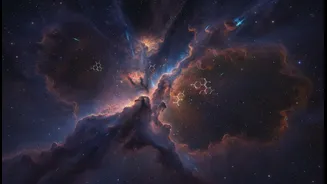
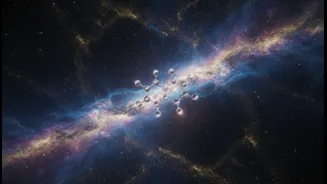
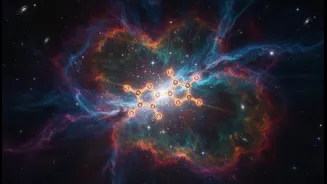
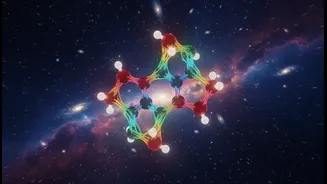
Scientists have announced the first-ever detection of a true sugar molecule, called erythrulose, in the interstellar medium—the thin veil of gas and dust that exists between stars. The discovery was made by an international team using two powerful radio
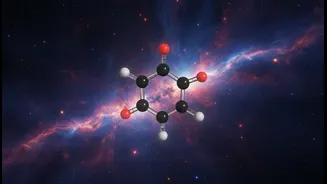
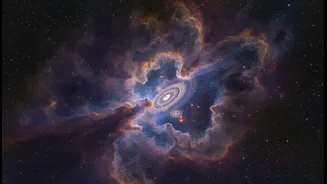
telescopes in Spain to peer into a massive, chemically rich molecular cloud named G+0.693-0.027, located about 26,700 light-years from Earth near the heart of the Milky Way. This cloud is a stellar nursery, a place where new stars and planets are born. On Earth, erythrulose is a simple four-carbon sugar found in small amounts in fruits like raspberries. Finding it in a cold, hostile cloud at temperatures around -250°C suggests that the chemistry of life can get a head start long before planets even form.
Why This Sugar Is a Big Deal
While you won't be sweetening your tea with it, the discovery of erythrulose is significant for the study of life's origins. Sugars are fundamental to biology, forming the structural backbone of RNA and DNA, the molecules that carry genetic instructions in all known life. Previously, scientists had found sugar-related molecules in meteorites and asteroid samples, which suggested these ingredients could be delivered to young planets. However, this new discovery confirms that a relatively complex sugar can form in deep space, independent of any star or planet. It suggests that the raw materials for life might not be a rare accident but a common byproduct of the processes that build stars and galaxies.
Rewriting the Planetary Recipe Book
This finding directly impacts models of how planets and life begin. Many theories assumed that the complex organic molecules necessary for life formed on the surface of young planets like Earth. The presence of erythrulose in an interstellar cloud suggests a different model: the ingredients were pre-mixed. Instead of starting from scratch, a newly forming planet could be seeded with these crucial molecules as it coalesces from the same dust and gas cloud. The research team even calculated that during an intense period of asteroid impacts billions of years ago, millions of tonnes of erythrulose could have been delivered to early Earth, providing a rich inventory for prebiotic chemistry.
A New Path for Finding Life’s Precursors
What makes the discovery even more compelling is what wasn't found. The team searched for simpler, three-carbon sugars but detected none, while finding erythrulose, a four-carbon sugar, in relative abundance. This challenges the long-held view in astrochemistry that complex molecules build up slowly by adding one carbon atom at a time. Instead, it appears erythrulose may form from the combination of simpler two-carbon molecules on the icy surfaces of dust grains. This opens up new possibilities for how other, even more biologically relevant molecules might form. Scientists are excited that this same method could be used to search for other sugars like ribose, a key component of RNA.