

Meet 'Pushpak': India's Space Shuttle
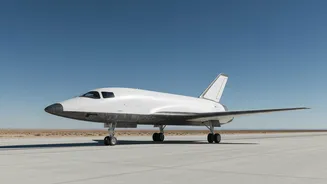
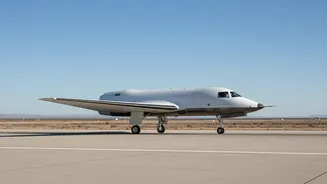
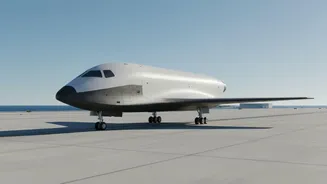
At the heart of India's reusability ambitions is the Reusable Launch Vehicle–Technology Demonstrator (RLV-TD), affectionately named 'Pushpak'. This uncrewed, winged vehicle is designed much like a spaceplane. The core idea is to create a vehicle that
can launch vertically like a rocket, deploy a satellite in orbit, fly back through the atmosphere, and land horizontally on a runway just like an aircraft. This 'fly-back' capability is the game-changer. Instead of the most expensive and technologically complex parts of a rocket burning up or crashing into the ocean, they can be recovered, refurbished, and flown again, drastically cutting the cost of future missions.
The Challenge of a Perfect Landing
While the concept sounds straightforward, the execution is a monumental engineering challenge. ISRO's recent efforts have focused on a critical series of tests known as the Landing Experiment (LEX). In these tests, conducted at the Aeronautical Test Range in Chitradurga, Karnataka, the Pushpak vehicle is lifted to an altitude of 4.5 kilometres by an Indian Air Force Chinook helicopter and then released. From there, the vehicle has to autonomously navigate its way to a runway and perform a perfect landing. This simulates the final, crucial phase of a return from space. The vehicle approaches the runway at over 320 kmph, faster than a commercial jetliner, making the autonomous landing a high-stakes manoeuvre. ISRO has now successfully completed three such tests, with the latest one demonstrating the vehicle's ability to handle more challenging wind conditions and correct its course from a greater deviation.
Why Winged Re-entry is Key
The winged design is fundamental to this entire process. Unlike capsules that return via parachutes and often land in the sea, a winged vehicle offers a controlled, gliding descent. This precision allows it to target a specific runway, making recovery and reuse far simpler and faster. The wings and control surfaces (elevons and rudders) allow the vehicle to be steered during its hypersonic re-entry, managing the immense heat and aerodynamic forces. A key success of the recent LEX missions was proving that Pushpak's autonomous navigation, guidance, and control systems can execute these precise manoeuvres flawlessly. Impressively, the winged body and flight systems from the second landing test were reused for the third test without modification, demonstrating the robustness and reusability of the hardware.
The Billion-Dollar Question: How It Saves Money
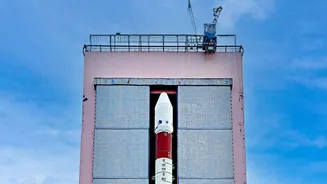
The primary driver for developing reusable technology is cost. The structure and engines of a launch vehicle account for up to 80% of its total cost, with fuel being a relatively small fraction. By creating a vehicle where these high-value components can be used for multiple missions, ISRO aims to slash the cost of launching a satellite into orbit by a factor of ten. This would significantly lower the barrier to space for commercial satellite companies, scientific missions, and even future human spaceflight programs like Gaganyaan. A lower launch cost makes India an even more competitive player in the global satellite launch market, an area where ISRO's PSLV rocket has already established a reputation for reliability and affordability.
The Road Ahead: A Two-Stage Orbital Vehicle
Pushpak and the LEX tests are crucial steps, but they are part of a much larger plan. They serve as a technology demonstrator for a future two-stage-to-orbit (TSTO) launch vehicle. In this concept, a reusable winged vehicle like Pushpak would act as the second stage, carried to a high altitude by a reusable first-stage booster. After releasing the second stage, the booster would return for a vertical landing, similar to what SpaceX's Falcon 9 does. The winged second stage would then continue into orbit, deploy its payload, and fly back to land on a runway. With the landing experiments complete, ISRO will move on to the next phases, including an orbital re-entry experiment (OREX), to test the vehicle's ability to withstand the extreme heat of returning from orbit.