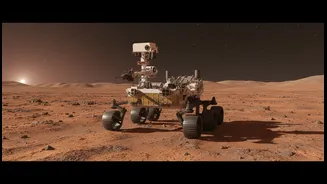









The Brains: Thinking for Itself on Another Planet
You can’t joystick a rover in real-time when a signal can take over 20 minutes to travel from Earth to Mars. That's why Perseverance has a sophisticated brain called AutoNav. Unlike older rovers that had to stop, take pictures, and wait for instructions,
Perseverance can 'think while driving'. Using its cameras, it builds a 3D map of the terrain in front of it, identifies hazards like sharp rocks or sand traps, and plots the safest, most efficient path forward—all on its own. This self-driving capability allows it to travel much farther and faster than its predecessors, covering more ground for scientific discovery each day. It's less like a remote-controlled car and more like a self-driving vehicle navigating a completely unknown wilderness millions of miles away.
The Commands: A Long-Distance Conversation with Mars
While AutoNav handles the moment-to-moment driving, the big picture plan comes from Earth. Engineers at NASA's Jet Propulsion Laboratory act as the mission's navigators. They don't send individual driving commands but rather a whole day's worth of activities at once. This 'playlist' tells the rover where to go, what rocks to analyse, and when to take pictures. To send these complex instructions, NASA uses its Deep Space Network (DSN), a global system of massive radio antennas. However, sending data directly from Earth to the rover is often inefficient. Most of the time, the commands are first sent to one of several orbiters circling Mars, which then relay the message down to Perseverance. This relay system is faster and more reliable, like using a local cell tower to connect a long-distance call.
The Body: Hardware Built for a Hostile World
Surviving on Mars requires incredibly tough hardware. After the previous rover, Curiosity, experienced significant wheel damage from sharp rocks, engineers gave Perseverance a major upgrade. Its six wheels are made from thicker, more durable aluminium. Though slightly narrower, they have a larger diameter and feature curved titanium spokes that act like springs for support. This robust design, combined with a 'rocker-bogie' suspension system that keeps weight evenly distributed, allows the rover to climb over obstacles and navigate rough ground safely. This tough exterior protects the sophisticated science instruments and electronics housed inside the rover's body, ensuring they can withstand the harsh Martian environment for years on end.
The Heartbeat: A Nuclear-Powered Battery
To power this marathon journey, Perseverance can't rely on solar panels, which can be covered by dust and are useless during the frigid Martian nights. Instead, it has a nuclear-powered 'battery' called a Multi-Mission Radioisotope Thermoelectric Generator, or MMRTG. This isn't a nuclear reactor. It contains about 4.8 kilograms of plutonium-238, which naturally decays and produces heat. The MMRTG converts this heat directly into a steady, reliable flow of about 110 watts of electricity. This constant power source keeps the rover's systems running and its instruments warm, allowing it to operate 24/7 for a mission designed to last well over a decade. It’s the constant, reliable heartbeat that makes this long-duration mission possible.