





The Silent Majority of Black Holes
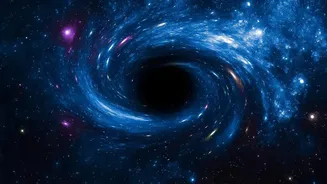
The celebrity black holes we see in dramatic artist impressions are the exception, not the rule. They are 'active' because they are feeding on nearby material, a process that heats up gas and dust into an accretion disk that glows brightly, especially
in X-rays. But what about a black hole that has nothing nearby to consume? It becomes dormant, a quiet concentration of mass that emits no light of its own. Estimates suggest our Milky Way galaxy could contain as many as 100 million of these stellar-mass black holes, the collapsed remnants of giant stars. The vast majority of them are likely to be these 'invisible' or 'dormant' objects, making them exceptionally difficult to detect through traditional means that rely on seeing light or radiation.
Hunting for a Gravitational Fingerprint
If you can't see the object itself, you have to look for its influence on the things you can see. Astronomers use two main indirect methods to hunt for these invisible giants. The first is astrometry, which is the hyper-precise measurement of the positions and movements of stars. If a visible star has an unseen, massive companion like a black hole, it won't travel in a straight line. Instead, it will 'wobble' as it orbits their shared center of mass. The second method is gravitational microlensing. As a black hole passes almost directly in front of a distant star, its immense gravity bends and magnifies the star's light from our perspective, causing the star to briefly and characteristically brighten.
The Necessity of Patience and Time
This is where the decade of data becomes critical. Both detection methods rely on observing changes that happen over very long timescales. A star orbiting a black hole might take years, or even decades, to complete a single path. A short observation might not capture enough of this wobble to be noticeable. You need a long, continuous baseline of data to trace the star's movement and confirm that its strange dance is caused by a massive, dark companion. Similarly, microlensing events caused by black holes are rare and can last for a long time. Confirming such an event requires separating it from the star's own intrinsic variability, which again demands a deep, historical record of its brightness levels. A few snapshots in time are not enough; astronomers need the whole movie.
The Gaia Mission: A Galactic Mapper
The European Space Agency's (ESA) Gaia mission is the technological powerhouse making this long-term search possible. Launched in 2013, Gaia's job is to create an unprecedentedly precise 3D map of over a billion stars in our galaxy. By repeatedly scanning the sky and measuring the exact position, motion, and brightness of each star, Gaia is building the exact decade-plus dataset needed to spot the subtle wobbles and flickers that betray the presence of invisible black holes. Discoveries of dormant black holes like Gaia BH1, Gaia BH2, and the exceptionally massive Gaia BH3 were made possible by sifting through Gaia's extensive data releases, revealing stars that were being tugged by unseen companions. These discoveries represent a fundamental shift in our ability to find this hidden population.
From Data Points to Discovery
Collecting the data is only half the battle. The sheer volume of information produced by missions like Gaia is measured in petabytes—thousands of times larger than a typical home computer's storage. It requires immense computational power and sophisticated algorithms to process this information, cross-reference observations taken years apart, and flag candidate stars for further investigation. Scientists in collaborations like Gaia's 'Black Hole Task Force' are essentially cosmic detectives, looking for tiny deviations from the norm in a sea of billions of data points. Each confirmed invisible black hole helps refine our understanding of how stars evolve and die, and how our galaxy was built. This patient, data-intensive approach is finally turning a theoretical population of black holes into a catalog of confirmed objects.