
The Case of the Vanishing Planet
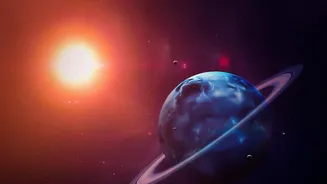
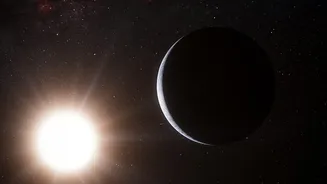
The mystery revolves around an object known as Fomalhaut b. First directly imaged by the Hubble Space Telescope in 2008, it was celebrated as one of the first exoplanets ever seen in visible light. Located about 25 light-years from Earth, it appeared
as a distinct point of light orbiting the bright star Fomalhaut. However, subsequent observations held a surprise. Instead of behaving like a stable planet on a predictable path, Fomalhaut b was acting strangely. It was surprisingly bright in visible light but had no detectable infrared signature, meaning it was unusually cold for a planet. More puzzlingly, as astronomers tracked it over the years, it appeared to be fading. By 2014, in images taken by Hubble, the once-celebrated exoplanet had completely disappeared. Planets don’t just vanish, so where did it go?
A Cosmic Cold Case in the Archives
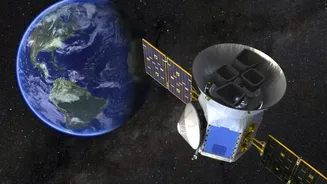
The key to solving this puzzle lay not in pointing telescopes at the sky for new information, but in digging through what we already had. Telescopes like Hubble and the Transiting Exoplanet Survey Satellite (TESS) have been observing the cosmos for years, creating vast archives of data. These archives are a digital treasure trove for astronomers, containing countless observations that can be re-analyzed with new techniques and fresh eyes. A team of astronomers decided to treat the Fomalhaut b case like a cosmic detective story. They went back to the source: all the archival Hubble images of the system taken over a decade. By meticulously reviewing this timeline of data, they hoped to find clues that were missed the first time around, when the initial excitement of discovering a new planet was paramount.
A Ghost in the Machine
The re-examination painted a completely different picture. The team confirmed that Fomalhaut b was not only fading but also seemed to be expanding over time. Furthermore, its trajectory suggested it was on a path to escape the star's gravity altogether, something a planet in a stable orbit should not do. These clues pointed to a startling conclusion: Fomalhaut b was never a planet. Instead, what astronomers had first seen in 2004 was something far more dramatic and fleeting: a massive, expanding cloud of incredibly fine dust. The original 'dot of light' was the bright, condensed aftermath of a colossal collision between two large celestial bodies.
The Aftermath of a Giant Collision
The new hypothesis suggests that two massive icy bodies, each estimated to be about 200 kilometres in diameter, smashed into each other. The violent impact created an enormous cloud of dust and ice particles that was initially bright enough for Hubble to detect. This event likely occurred shortly before the first observations in 2004. What astronomers witnessed over the next ten years was this debris cloud expanding and dispersing into space. As the particles spread out, the cloud grew fainter until it became too diffuse for Hubble to see, creating the illusion of a vanishing planet. This theory perfectly explained all the oddities: the brightness in visible light (from dust reflecting starlight), the lack of heat, and the escape trajectory. It was not a planet disappearing, but the evidence of a cosmic crash fading away.
The Value of Cosmic Archaeology
While the loss of a 'planet' might sound disappointing, the reality is far more exciting. Witnessing the aftermath of a planetary-scale collision is incredibly rare; events like this are estimated to occur in the Fomalhaut system only once every 200,000 years. The discovery provides a unique snapshot of the chaotic processes that shape planetary systems, including our own. It shows that re-analyzing archival data is a powerful tool for discovery. As our data processing techniques and algorithms improve, astronomers can essentially go back in time, applying modern methods to old observations to uncover secrets that were hidden in plain sight. This success story validates the growing field of 'space archaeology' and suggests that many more discoveries may be lying dormant in our vast archives, just waiting for a fresh look.