





The Origin Story: Unrefined vs. Refined
Both jaggery and white sugar start their journey from the same place: sugarcane juice (or sometimes palm sap for jaggery). The key difference lies in the processing. To make jaggery, the juice is boiled until it thickens and solidifies. This minimal processing means
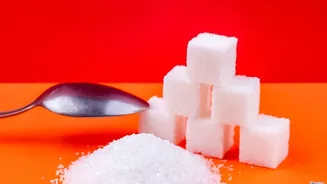
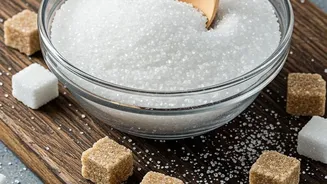
it retains molasses, which is a nutrient-rich byproduct. White sugar, on the other hand, undergoes extensive industrial refining that strips away the molasses and all other minerals, leaving behind pure, crystalline sucrose. This is why jaggery has its characteristic golden-to-dark-brown colour and complex flavour, while sugar is neutral, white, and purely sweet.
A Nutritional Deep Dive
Because it retains molasses, jaggery contains several minerals that white sugar lacks entirely. It is a source of iron, potassium, magnesium, and calcium. However, it's crucial to look at this in the context of a normal serving size. While 100 grams of jaggery can offer a significant amount of these minerals, a typical 10-gram serving provides a much smaller, almost negligible, percentage of your daily needs. So, while jaggery is nutritionally superior per gram, you would have to consume a very large and unhealthy amount to get substantial mineral benefits. White sugar contains what are often called 'empty calories', meaning it provides energy without any vitamins or minerals.
The Impact on Blood Sugar
This is where one of the biggest myths about jaggery is busted. Many believe that because it's 'natural', jaggery is safer for blood sugar levels. However, studies show that sugarcane jaggery has a high Glycemic Index (GI), often measuring around 84. This is even higher than white sugar, which has a GI of about 65. A higher GI means that the food raises blood sugar levels more quickly. Jaggery is still composed of 65-85% sucrose, the same compound as table sugar. For individuals managing diabetes or insulin resistance, both sweeteners should be treated with caution and consumed in very limited quantities, as neither is a 'safe' option.
The Winter Wellness Connection
In many Indian households, jaggery is a winter staple, valued for its traditional health benefits. It is widely believed to have a warming effect on the body and is often consumed to help with colds, coughs, and respiratory issues by clearing the respiratory tract. It is also thought to aid digestion when eaten after a meal. While these benefits are a cornerstone of Ayurvedic practice, much of the evidence is traditional rather than based on modern clinical studies. The energy boost it provides is real, as both jaggery and sugar are calorie-dense carbohydrates.
Calories and Weight Management
When it comes to calories, there is virtually no difference between the two. Jaggery contains about 383 calories per 100 grams, while white sugar has around 387 calories. This means that swapping sugar for jaggery will not help with weight loss. The key to managing weight is controlling the total amount of sweetener consumed, not just switching the type. Both are concentrated sources of sugar, and excess consumption will contribute to weight gain and other health issues.