

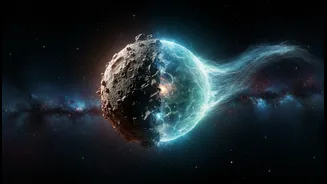


A Comet in Asteroid's Clothing
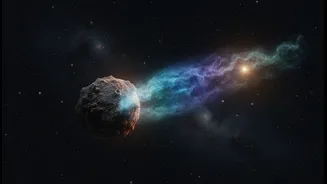
Meet 2060 Chiron. When it was discovered in 1977, it was labelled an asteroid, one of many chunks of rock orbiting the Sun between Saturn and Uranus. For over a decade, that was its story. But in 1989, astronomers noticed something strange: Chiron had
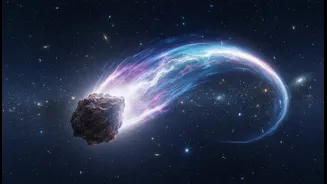
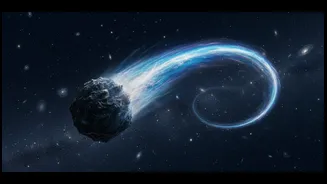
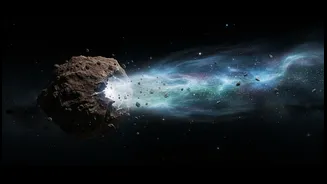
developed a faint, glowing cloud around it, a feature known as a coma. This is the classic signature of a comet, whose ices turn to gas as it warms near the Sun. Suddenly, this supposedly inert rock had a dual identity. Today, it is officially classified as both a minor planet and a comet, a prime example of a special class of objects called Centaurs, named after the mythical half-human, half-horse creatures. These bodies exhibit traits of both asteroids and comets, forcing us to reconsider our simple definitions.
The Classic Celestial Divide
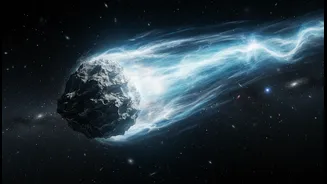
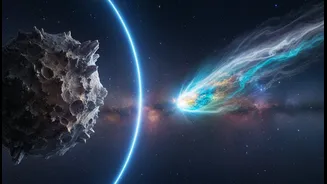
For a long time, the distinction seemed straightforward. Asteroids were thought to be dry, rocky, and metallic objects, remnants from the formation of the inner planets. Most of them reside in the asteroid belt between Mars and Jupiter. Comets, on the other hand, are the “dirty snowballs” of the solar system, born in the frigid outer reaches like the Kuiper Belt and Oort Cloud. Composed of rock, dust, and frozen gases, they develop spectacular tails and comas only when their eccentric orbits bring them close enough to the Sun for their ices to sublimate, or turn directly from solid to gas. One is a mostly lifeless rock; the other is a dynamic, active body. This clear division helped us map the solar system and understand its history.
When Rocks Start to Fume
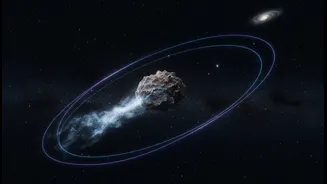
Chiron was just the beginning. Scientists have since found a whole new category of perplexing objects known as "active asteroids" or "main-belt comets." These bodies follow the relatively stable, circular orbits of asteroids within the main belt but display comet-like activity, such as tails and dust clouds. This discovery was shocking because the asteroid belt is considered too warm for surface ice to have survived for billions of years. The leading theory is that these objects are essentially icy asteroids, where water ice has remained buried beneath the surface, protected from the Sun. Occasionally, an impact might expose this ancient ice, or a subtle shift in orbit could provide just enough extra solar energy to kickstart sublimation, effectively waking up a dormant comet that has been hiding in plain sight.
The Scientific Value of Fuzzy Edges
These boundary-crossing objects are far more than just celestial curiosities. They are scientific treasures that provide crucial insights into the history and evolution of our solar system. Centaurs, for example, are believed to be in a transitional phase, migrating from their home in the outer solar system inwards. Studying them gives us a snapshot of this process in action. Active asteroids in the main belt suggest that water and other volatile materials may be far more widespread in the inner solar system than previously thought. This has significant implications for understanding how Earth got its water, a key ingredient for life. These objects are essentially time capsules, carrying pristine material from the dawn of the solar system and revealing that its various regions are more interconnected than we once believed.