







The National Tragedy in White
The story of the yellow jersey begins not with a victory, but with a soul-crushing defeat. Before 1950, Brazil’s national team played in a simple white kit with blue collars. That year, the FIFA World Cup was held in Brazil, and the nation was utterly
convinced of its destiny to win. In the final match against Uruguay, played at the newly built Maracanã stadium in front of an estimated 200,000 fans, Brazil needed only a draw to secure the trophy. But in a stunning upset that is still spoken of with dread, Uruguay won 2-1. The event, known as the 'Maracanazo' (The Maracanã Smash), was declared a national tragedy. In the aftermath, the white kit was seen as a symbol of this failure, deemed unpatriotic and unlucky, and it was decided that it had to be retired forever.
A Competition to Create a New Identity
To exorcise the ghosts of 1950, a national competition was launched in 1953 by the newspaper Correio da Manhã, in collaboration with the Brazilian Sports Confederation. The goal was to design a new uniform that would better represent the nation's identity and spirit. The only rule was that the new design must incorporate all four colours of the Brazilian flag: green, yellow, blue, and white. The idea was to create something that visually connected the team to the flag and fostered a new sense of national pride, moving away from the cursed white shirts. Hundreds of entries were submitted, each hoping to capture the essence of a nation desperate for a fresh start.
The 'Canarinho' is Born
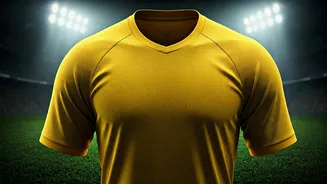
The winning design came from an unlikely source: Aldyr Garcia Schlee, a 19-year-old newspaper illustrator from a small town on the border with Uruguay. In a strange twist of fate, Schlee was actually a supporter of the Uruguayan team that had inflicted so much pain on Brazil. His genius was in the interpretation of the rules. He realised the four flag colours didn't all have to be on the shirt itself. His design proposed a vibrant yellow shirt to represent gold and the nation's wealth, with green trim; blue shorts to represent the sky; and white socks. His creation was nicknamed the 'Canarinho' (Little Canary) and was first worn by the national team in a match against Chile in 1954. A new era had begun.
From New Kit to Global Icon
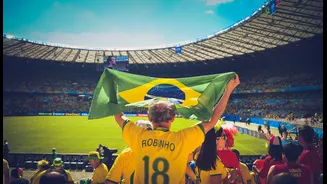
The Canarinho jersey soon became a symbol of triumph. In 1958, just eight years after the Maracanazo, a 17-year-old prodigy named Pelé led Brazil to its first-ever World Cup victory in Sweden. The team wore the yellow jersey on their path to glory, and an icon was born. That victory transformed the kit from a simple uniform into a global symbol of 'Joga Bonito' (The Beautiful Game) — a joyful, attacking, and irresistibly creative style of football. Brazil went on to win four more World Cups (1962, 1970, 1994, 2002) while wearing the yellow kit, cementing its status as the most successful and recognized jersey in international football. It came to represent not just a team, but a whole philosophy of the sport.
A Symbol of Division and Reconciliation
In recent years, the story of the yellow jersey has taken a complex turn. The shirt was widely adopted by supporters of former President Jair Bolsonaro, becoming a prominent symbol at his political rallies. This politicisation caused a deep rift, with many Brazilians, particularly those on the left, feeling alienated from their own national symbol. Some fans even opted to wear the blue away kit or older jerseys to avoid being associated with the far-right movement. Following the 2022 election of Luiz Inácio Lula da Silva, there has been a conscious effort by politicians, celebrities, and the Brazilian Football Confederation (CBF) to reclaim the jersey as a unifying symbol for all Brazilians, regardless of political affiliation. This struggle over its meaning continues, reflecting the deep divisions within the country itself.