




The Clock Is Broken
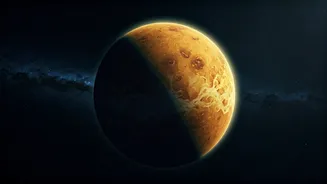
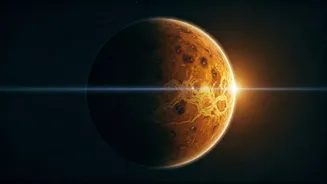
Let’s get the mind-bending numbers out of the way first. A year on Venus—the time it takes to complete one orbit around the Sun—is about 225 Earth days. This is fairly straightforward. Now, for the day. A day, defined as one full rotation on its axis,
takes a staggering 243 Earth days. That’s right: a single Venusian day is 18 Earth days longer than an entire Venusian year. If you were standing on its surface, the planet would complete its entire journey around the Sun before it finished spinning on its axis just once. It’s the slowest rotation of any planet in our solar system, making its daily cycle fundamentally alien to our own.
Spinning the Wrong Way
To make things even stranger, Venus doesn’t just spin slowly; it spins backward. Every planet in our solar system except for Venus and Uranus rotates counter-clockwise on its axis, the same direction in which they orbit the Sun. This is called prograde motion. Venus, however, has a retrograde rotation, meaning it spins clockwise. If you could survive on its surface, you would see the Sun rise in the west and set in the east. This peculiar backward spin is a critical clue in understanding why its day is so incredibly long. Scientists are still piecing together the full story, but they have a couple of compelling theories.
A Violent Past or a Heavy Atmosphere?
So why is Venus so weird? One leading theory suggests a cataclysmic event in its distant past. Billions of years ago, a massive asteroid or planetary body might have collided with Venus, hitting it with such force that it not only slowed its rotation to a crawl but actually reversed it. This idea paints a picture of a solar system that was once a chaotic cosmic billiard table. A more recent and equally fascinating theory points to Venus's own atmosphere. Venus is shrouded in a thick, heavy blanket of carbon dioxide that is 90 times denser than Earth's atmosphere. This crushing atmosphere creates powerful thermal tides, caused by the Sun heating the air. Over billions of years, the gravitational pull on this dense, sloshing atmosphere could have acted as a powerful brake, slowing the planet’s original spin and eventually flipping it into its current retrograde crawl.
A Tale of Two Days
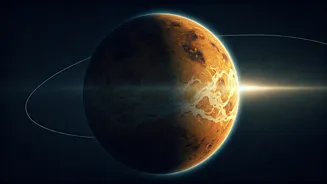
Here’s a final twist. While a full rotation (a sidereal day) is 243 Earth days, the time from one sunrise to the next (a solar day) is much shorter, at around 117 Earth days. How is this possible? It’s a strange cosmic dance between the planet’s slow backward spin and its forward orbit around the Sun. As Venus slowly rotates in one direction, it's also moving along its orbit in the opposite direction. The combination of these two opposing motions means that a specific point on the surface faces the Sun again more quickly than it completes a full 360-degree turn. Still, with a 'day' lasting nearly four Earth months, it’s not exactly a place for the impatient.
Earth's Twisted Sister
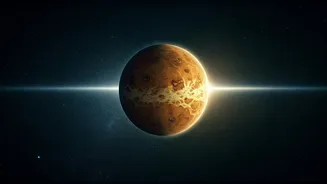
For a long time, Venus was called Earth’s twin because of its similar size and mass. But the more we learn, the more it seems like our twisted sister. Its bizarre timekeeping is just one feature of an extreme environment. With surface temperatures hot enough to melt lead (around 465°C), a crushing atmospheric pressure equivalent to being 900 meters underwater, and clouds of sulfuric acid, Venus is a cautionary tale of how a planet can evolve. It reminds us that the stable, predictable cycle of day and night we enjoy on Earth is not a cosmic given but a precious and delicate balance.