







First, What Is an Optical Skyrmion?
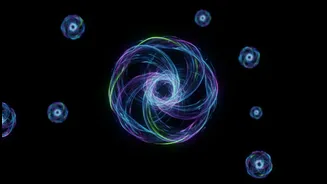
At its core, an optical skyrmion is a tiny, stable, and twisted pattern of light. Think of it as a nanoscale knot tied in an electromagnetic field. Originally a concept from particle physics, skyrmions were first observed in magnetic materials before
scientists figured out how to create them with light. These light-based quasiparticles are unique because their topological structure makes them incredibly robust. Unlike a simple beam of light that dissipates, an optical skyrmion holds its shape, which makes it a fascinating candidate for carrying information.
Why Is There So Much Buzz?
The excitement surrounding optical skyrmions comes from their immense potential. Scientists believe these stable light structures could be building blocks for the next generation of technology. Their ability to encode and store information in tiny, durable packages could lead to revolutionary advances in data storage, telecommunications, and high-speed computing. Because they can be manipulated with light, they promise more energy-efficient and faster devices. The potential applications extend to high-resolution imaging and even quantum technologies, which explains why terms like "game-changer" are often attached to them.
The Verification Checklist: Check the Source
Before you share a headline about a skyrmion-powered revolution, the first step is to check the source. Is the claim coming from a press release, a news aggregator, or a peer-reviewed scientific journal? A press release from a university or company is designed to generate excitement, and may use hyperbolic language. Reputable journals like Nature or Science, however, put studies through a rigorous peer-review process where other experts in the field scrutinize the work before it's published. While not foolproof, publication in a high-impact journal is a strong indicator of credibility.
The Verification Checklist: Understand the Study's Stage
A common point of exaggeration is the stage of the research. Is the claim based on a computer simulation, a controlled lab experiment, or a functional prototype? Many "breakthroughs" reported in the media are based on theoretical models or results achieved under highly specific laboratory conditions. This is a crucial step in science, but it's a long way from a market-ready product. A recent discovery showed a simpler way to create optical skyrmions in a lab, which is significant for researchers but doesn't mean the technology is in your phone tomorrow. Always ask if the results have been replicated by an independent group, as reproducibility is the bedrock of valid science.
The Verification Checklist: Watch the Language
Pay close attention to the words used in the article. Science journalism often relies on sensational headlines to attract clicks. Be wary of terms like "breakthrough," "miracle," "cure," or "paradigm shift." True scientific progress is usually incremental, with each study adding a small piece to a larger puzzle. If an article makes a claim that seems too good to be true or promises to solve a massive problem overnight, it warrants extra skepticism. Look for reporting that explains the limitations of the study and provides context rather than just focusing on the most dramatic conclusion.
The Verification Checklist: Distinguish Correlation from Causation
This is a classic rule for reading any scientific report. An article might state that two things happened at the same time (correlation) and imply that one caused the other (causation). In the context of optical skyrmions, a lab might demonstrate a new property and also note an improvement in a theoretical data processing speed. A news report might incorrectly state the new property causes the speed improvement, when it's just a related finding. A good scientific report will be clear about what was directly observed and what is being inferred. Always be cautious when a story draws a direct causal link without explaining the precise mechanism confirmed by the researchers.