



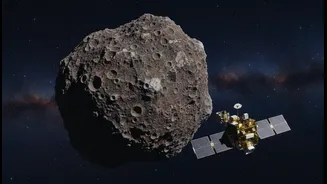


A Veteran Explorer's New Target
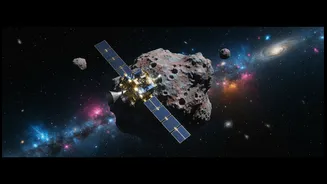
Japan's Hayabusa2 spacecraft is already a celebrated veteran of space exploration. After launching in 2014, it successfully rendezvoused with asteroid Ryugu, collected surface and subsurface samples, and returned them to Earth in December 2020. But instead
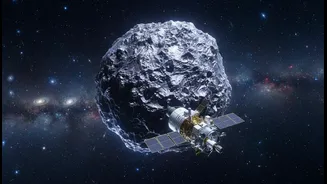
of powering down, the probe embarked on an extended mission. With plenty of fuel left in its advanced ion engines, the Japan Aerospace Exploration Agency (JAXA) sent it on a new, decade-long journey. The first major milestone of this new quest was the July 2026 flyby of a near-Earth asteroid known as 2001 CC21, which was officially named Torifune following a public contest. This encounter was a completely different challenge than the slow, careful dance Hayabusa2 performed at Ryugu.
The High-Speed Challenge
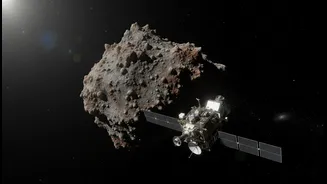
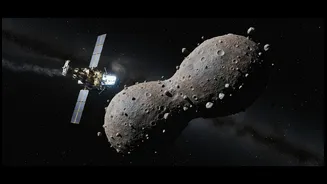
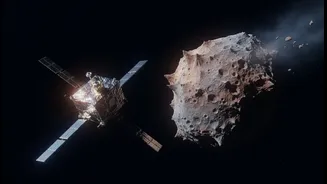
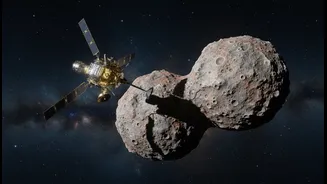
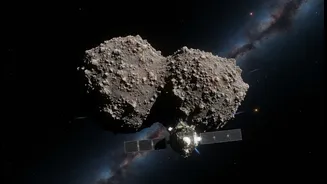
The flyby, which occurred on July 5, 2026, saw Hayabusa2 speed past Torifune at a blistering relative velocity of about 5 kilometres per second. The probe was never designed for this kind of high-speed intercept; its systems were built for slowly matching an asteroid's orbit to hover and land. The Torifune encounter was a crucial test of JAXA's autonomous navigation and optical guidance systems. Because of the immense distance, the spacecraft had to track the asteroid and execute its observations automatically, without real-time human input. The mission was a success, with the probe capturing detailed images that revealed Torifune to be an elongated, two-lobed asteroid, sometimes described as resembling a snowman. This manoeuvre demonstrated a vital new capability: the ability to intercept and analyse a fast-moving object on the first attempt.
Planning for Planetary Defense
This is where the mission connects directly to planning here on Earth. The flyby was, in essence, a dry run for planetary defense. Scientists are tracking thousands of near-Earth objects (NEOs), and while no large ones currently pose a threat, the risk of a future impact from a smaller, yet still dangerous, asteroid is real. Missions like this are essential for understanding what these asteroids are made of and how they are structured. More importantly, the technology tested at Torifune is exactly what would be needed for a mission to deflect a hazardous asteroid. Successfully performing a high-speed intercept proves that a kinetic impactor—a probe designed to crash into an asteroid to alter its course—is a feasible strategy. Each mission provides invaluable data for planning how to protect our planet from a potential cosmic threat.
The Technology That Trickles Down
Beyond the existential importance of planetary defense, the technology developed for missions like Hayabusa2 has broader applications. The probe's ultra-efficient ion engines, which use xenon propellant and solar power, are at the forefront of deep-space propulsion. This technology allows for long-duration missions with very little fuel, a concept that will be vital for future exploration and potential commercial activities in space. Similarly, the autonomous guidance systems are a major advancement. The ability for a machine to navigate, identify a target, and make decisions millions of kilometres from home has potential applications in robotics, logistics, and other automated systems on Earth. These missions push the boundaries of engineering, and the solutions often find their way into everyday technology over time.