



A Cosmic Demolition Derby
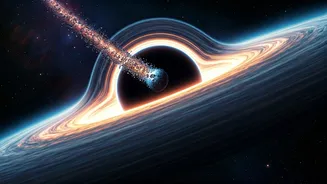
When a star wanders too close to a supermassive black hole, it’s a celestial point of no return. The black hole's immense gravitational pull exerts powerful tidal forces on the star. This gravitational tug-of-war is so extreme that it stretches and pulls
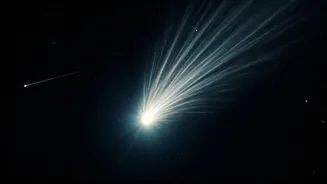
the star apart, a process astronomers graphically call 'spaghettification'. This dramatic event, scientifically known as a Tidal Disruption Event or TDE, unleashes an enormous burst of energy as the star's material is shredded and devoured. The resulting flare can briefly outshine all the stars in its host galaxy, giving astronomers a fleeting glimpse into one of the universe’s most violent phenomena.
Watching From Millions of Light-Years Away
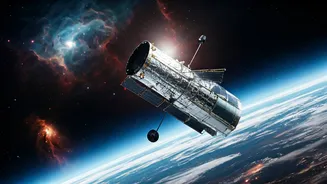
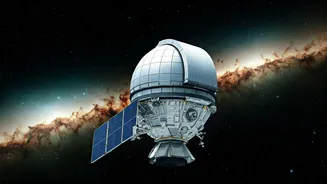
Observing a TDE is a stroke of cosmic luck and technological prowess. These events are rare, estimated to occur about once every 10,000 to 100,000 years in a galaxy like our own Milky Way. Astronomers use a network of ground-based and space telescopes, such as NASA's Swift Observatory and the Hubble Space Telescope, to catch them. When a TDE occurs, it releases a brilliant flash of light across the electromagnetic spectrum, from X-rays to radio waves. By studying how this light changes over days and weeks, scientists can piece together what is happening, even from millions of light-years away. This is what “real-time” observation means in astronomy: capturing the light as it finally reaches Earth after its long journey.
The Hunt in Hidden Places
For a long time, astronomers primarily found TDEs by searching for bright flashes in optical and X-ray light. This led to a puzzle: TDEs seemed to happen mostly in one rare type of galaxy. However, recent breakthroughs have changed the game. By searching in the infrared spectrum using missions like NASA's NEOWISE, scientists have started finding TDEs that were previously hidden by galactic dust. This dust can absorb optical and X-ray light but heats up and glows in the infrared, revealing the black hole's meal. This new technique recently allowed a team from MIT to identify 18 new TDEs, more than doubling the known catalogue and showing they occur in a wide variety of galaxies.
A Black Hole's Glowing Leftovers
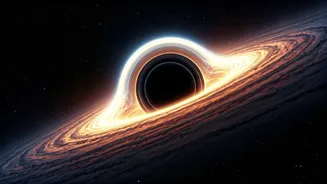
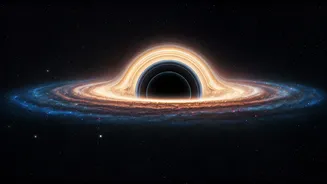
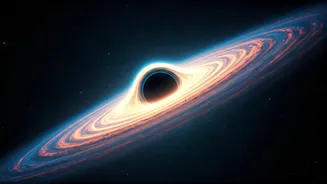
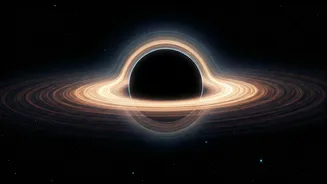
What scientists see isn't the black hole itself—which is invisible—but the superheated debris of the star forming a glowing disk around it. This accretion disk can reach temperatures of thousands of degrees, generating the light that telescopes detect. The characteristics of this light, from its brightness to its chemical signature, act as a forensic tool. They can reveal fundamental properties of the black hole, such as its mass and spin. Some TDEs, like one catalogued as AT2018fyk, have even shown repeated flares, suggesting the star wasn't completely destroyed in the first pass and has come back for a second, and possibly a third, devastating encounter.
Unlocking the Secrets of Giants
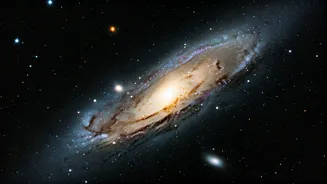
Studying these stellar demolitions does more than just satisfy our cosmic curiosity. Many supermassive black holes, especially at the centres of galaxies, are dormant and incredibly difficult to detect. A TDE provides a sudden flash of light that illuminates these sleeping giants, allowing astronomers to find and study them. This helps to build a census of black holes in the nearby universe and test theories about how they grow and influence the evolution of the galaxies around them. By watching a black hole eat, we learn more about the beast itself and its role in the cosmic ecosystem.