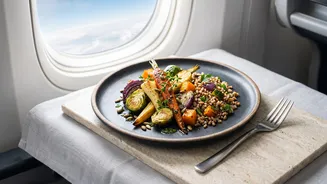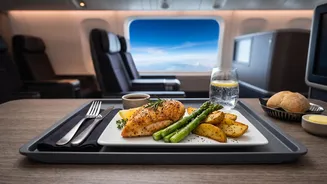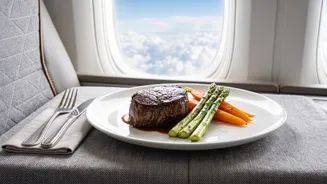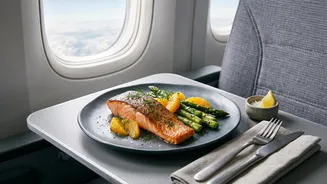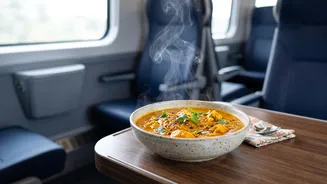








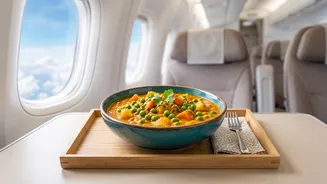
It’s a familiar scene: the unmistakable, mouth-watering aroma of a fellow passenger's biryani wafting through a train coach. Yet, on an aircraft, even a full meal service can feel strangely scentless. Why does the same food smell so different?
The Path of the Aroma
The primary
reason for this difference lies in how air moves. In most air-conditioned train coaches, the ventilation system is designed for thermal comfort, often pushing air lengthwise down the carriage. This allows smells, which are essentially volatile organic compounds (VOCs) carried in the air, to travel relatively freely from one end of the coach to another. So, when someone opens a container of flavourful food, the aroma molecules join this general airflow, making their way to your nose a few seats away. Studies on train carriage airflow show that while there is circulation, the air is not necessarily well-mixed along the entire length, allowing distinct scent plumes to travel.
An Aircraft's 'Air Curtain'
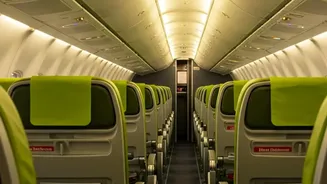
An aircraft cabin is a completely different world, engineered for high-altitude travel. The air circulation is meticulously designed not just for comfort, but for safety and purity. Air enters from overhead vents and flows downwards towards the floor, where it is extracted through grilles at the sides. This creates a vertical 'air curtain' effect within each few rows of seats. This pattern is specifically designed to minimise the fore-and-aft movement of air along the cabin, thereby containing the spread of airborne particles, including germs and, by extension, food aromas. The entire cabin's air is also completely refreshed every two to three minutes with a 50/50 mix of fresh and recirculated air.
The Filtration Factor
The air that is recirculated on a plane goes through a rigorous cleaning process. Most commercial aircraft are equipped with High-Efficiency Particulate Air (HEPA) filters, the same grade used in hospital operating theatres. These filters are incredibly effective, capturing over 99.9% of microscopic particles, including bacteria, viruses, and dust. While primarily designed for health and safety, these filters also trap many of the larger molecules that create food aromas. Train ventilation systems, while effective at temperature control, generally do not use HEPA-grade filters and are not designed with the same level of particulate filtration in mind, allowing more aroma molecules to continue circulating.
It's Not the Air, It's You
Beyond airflow, the environment inside an aircraft actively dulls your ability to smell and taste. At a cruising altitude of 35,000 feet, cabin air is pressurised to the equivalent of about 7,000 feet. This lower pressure, combined with extremely low humidity levels (sometimes as low as 5%), has a significant impact on our senses. The dry air dehydrates the mucous membranes in our nose, which are crucial for detecting scents. Studies have shown that this combination of low pressure and low humidity impairs our olfactory sensitivity, making it harder to perceive aromas. Your sense of taste for sweet and salty things can be reduced by up to 30%. A train coach, in contrast, maintains normal ground-level pressure and has significantly higher humidity, creating an environment where your nose works just as it should.