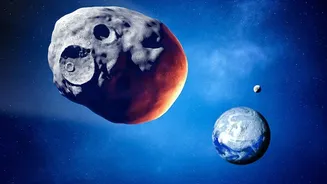


For a little while, our planet has more than one moon. A tiny asteroid, now named 2026 QQ8, has been temporarily captured by Earth’s gravity, becoming a short-lived companion on our journey around the Sun. Here's what you need to know.
Meet Earth’s Newest 'Minimoon'
Astronomers have
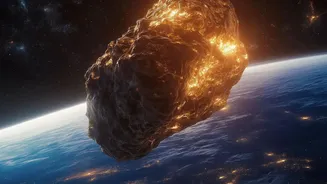
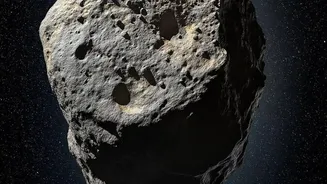
confirmed that a small asteroid, designated 2026 QQ8, was pulled into Earth's gravitational embrace in April 2026. The object was first spotted in August by Hungarian astronomer Krisztián Sárneczky, but it took several weeks of follow-up observations to confirm its nature. Initially, scientists weren't sure if it was a natural object or a piece of human-made space debris, like an old rocket stage. By tracking how solar radiation affected its movement, and with observations from telescopes in Arizona and Hawaii, they confirmed it was a natural space rock. Measuring only about two meters (or six feet) across, the asteroid is roughly the size of a large appliance and far too small and distant to be seen without powerful telescopes.
A Temporary Arrangement
Unlike our permanent Moon, which has been our constant companion for billions of years, 2026 QQ8 is just passing through. This isn't a stable, long-term relationship. The asteroid is expected to break free from Earth's gravity and continue on its own orbit around the Sun in early December 2026, though some estimates suggest it could linger until January 2027. Such temporary companions are often called 'minimoons' or 'quasi-satellites'. They are asteroids whose orbits around the Sun are very similar to Earth's. When they make a close pass at just the right speed and angle, the combined gravity of the Earth and Moon can nudge them into a temporary, chaotic orbit around our planet.
A Complex Cosmic Dance
The path of 2026 QQ8 is not a neat circle like our Moon's. Its orbit is highly irregular, sometimes described as a 'spaghetti-like wobble'. This is because it is caught in a complex gravitational tug-of-war between the Earth, Moon, and Sun. The asteroid is classified as an 'Aten asteroid', a group of space rocks that have orbits smaller than Earth's and occasionally cross our path. While large Aten asteroids can be a concern, 2026 QQ8 poses no threat. At its closest, it will still be about 1.5 times farther away than our Moon. Even if it were on a collision course, a rock this small would harmlessly burn up in our atmosphere, at most creating a bright fireball and a loud bang.
Not Our First Visitor
While the discovery is exciting, 2026 QQ8 is not the first temporary moon Earth has hosted. Astronomers have identified others, including 2006 RH120, which orbited Earth for about a year, and 2020 CD3, which stuck around for about three years. In fact, scientists believe that Earth likely has at least one minimoon companion at any given time, but they are incredibly difficult to find. Their tiny size, vast distances, and rapid movement make them elusive targets for current sky surveys. Most are captured for only a few weeks or months before being flung back out into their own solar orbit.
The Search for More
The detection of 2026 QQ8 highlights the dynamic and ever-changing nature of our solar system neighborhood. It also showcases the growing power of asteroid-hunting programs that scan the skies every night. The process of spotting these objects involves automated surveys that flag fast-moving targets, which are then followed up by other observatories to confirm their orbits and nature. In the near future, the Vera C. Rubin Observatory in Chile is expected to revolutionize this field. By scanning the entire sky every few nights with unprecedented depth, it is expected to discover a vast number of new solar system objects, including many more of these fleeting minimoons that have so far gone unnoticed.