







The Invisible Danger During Descent
Getting into space is only half the battle; the return journey is arguably more perilous. As the Gaganyaan crew module hurtles back to Earth at tremendous speeds, it faces extreme heat and pressure. Once it has slowed from hypersonic speeds, the next
major challenge begins: a stable descent through the atmosphere. This is where high-altitude winds and aerodynamic forces can become violent adversaries. Uncontrolled buffeting or tumbling could put immense stress on the capsule and its occupants, potentially compromising the final, most crucial phase of the mission before splashdown. The entire landing sequence depends on taming these forces.
A Ten-Parachute Shield
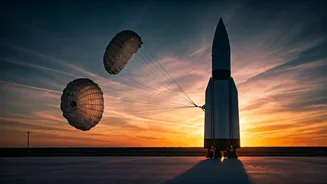
To counter this, ISRO has developed a sophisticated, multi-stage deceleration system that relies on a total of 10 parachutes of four different types. This is not just about having one big canopy. The system is a carefully choreographed sequence, often referred to as a deployment matrix or cascade. It begins with two Apex Cover Separation parachutes to clear the way. They are followed by two crucial Drogue Parachutes, which are specifically designed to stabilize the fast-moving capsule and reduce its velocity significantly in the thin upper atmosphere. Only after the drogues have done their job do the final sets of parachutes come into play.
The Deployment Matrix Explained
The term 'matrix' refers to this complex, layered deployment logic. After the drogue parachutes have stabilized the module against wind buffeting, three Pilot Parachutes are deployed. Their job isn't to slow the capsule, but to pull out the three large Main Parachutes in a controlled manner. This staged approach is the key to neutralizing violent forces. By deploying smaller, stronger drogues first, ISRO ensures the module is correctly oriented and descending at a manageable speed before the massive main canopies open. This prevents the sudden shock that would occur if a large parachute opened at high speed, which could tear the canopy apart or damage the capsule. It's a gradual, step-by-step process of taming the descent.
Reefing: A Clever Trick to Cheat the Wind
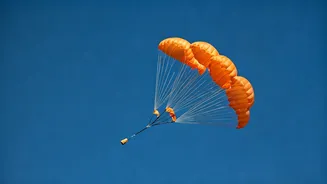
Another critical technique used in the Gaganyaan parachute system is 'reefing'. This involves deploying a parachute in a partially closed state by using restraining lines. This restricts the canopy’s diameter, allowing it to inflate gradually rather than all at once. This significantly reduces the enormous opening shock in a high-speed environment. After a few seconds, pyro-based cutters sever the reefing lines, allowing the parachute to inflate to its full size for maximum drag. This smart technique, used for both drogue and main parachutes, is essential for managing the extreme aerodynamic forces and ensuring the system's structural integrity.
Tested for a Safe Homecoming
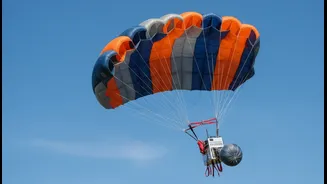
This entire system has been undergoing rigorous testing. In a recent key test known as the Integrated Main Parachute Airdrop Test (IMAT), ISRO successfully dropped a dummy payload from an altitude of 2.5 km to qualify the main parachute under maximum load conditions. This test, the fifth in a series, validated the structural integrity of the main parachute. Performed in collaboration with DRDO, the Indian Air Force, and the Army, these tests build confidence in the system's reliability ahead of the first uncrewed Gaganyaan (G1) mission. Each successful drop proves that the complex sequence is ready to protect India’s astronauts.