


A New Window to the Cosmos
Set to launch aboard a SpaceX Falcon Heavy rocket on August 30, 2026, the Nancy Grace Roman Space Telescope is NASA's next great observatory. Named after the agency's first chief of astronomy, Nancy Grace Roman, this mission is designed to tackle two
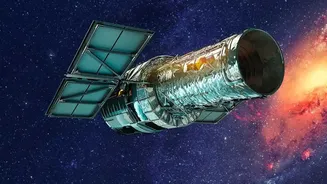
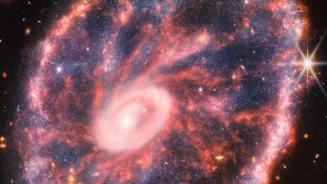
of the most profound questions in cosmology: the nature of dark energy and the prevalence of planets beyond our solar system. While telescopes like Hubble and James Webb (JWST) provide stunning, detailed close-ups of cosmic objects, Roman is built for breadth. Its primary mirror is the same size as Hubble's, but its Wide Field Instrument will capture a patch of the sky over 100 times larger in a single snapshot. This incredible field of view will allow it to map the universe at a speed between 100 and 1,000 times faster than Hubble, creating vast cosmic panoramas with breathtaking clarity.
The Hunt for Dark Energy
One of Roman's primary objectives is to investigate dark energy, the mysterious force causing the universe's expansion to accelerate. Scientists know this is happening, but they don't know why. It could be a new type of energy field or a property of spacetime itself. Roman will probe this mystery by conducting a massive survey of over a billion galaxies across cosmic time. By precisely measuring their distribution and movement, the telescope will trace the expansion history of the universe. It will use three key methods: studying the faint ripples of sound waves from the early universe known as baryon acoustic oscillations, observing thousands of distant supernovae, and measuring how the gravity of dark matter bends the light from galaxies, a technique called weak gravitational lensing. These observations will provide crucial data to help scientists understand how dark energy has shaped the cosmos over billions of years.
A Census of Alien Worlds
Beyond the grand scale of cosmology, Roman will also conduct an unprecedented census of exoplanets. While previous missions have confirmed around 6,000 planets, Roman is expected to find more than 100,000 new worlds on its own. It will primarily use a powerful technique called gravitational microlensing. This method detects planets by observing the way their gravity, combined with their star's, bends and magnifies the light from a more distant, unrelated star that passes behind them. Microlensing is particularly effective at finding planets far from their host stars, including rogue planets that wander the galaxy unbound to any star. This will give astronomers a more complete picture of planetary systems, helping to answer whether systems like our own are common or rare in the galaxy.
More Than One Way to Find a Planet
In addition to microlensing, Roman's vast survey will also detect tens of thousands of planets using the transit method, where a planet periodically dims its star's light as it passes in front. This dual approach allows the mission to find a diverse range of planets, from those orbiting very close to their stars to those much farther out. Furthermore, Roman is equipped with a Coronagraph Instrument, a technology demonstrator that will block the overwhelming glare of a star to take direct images of Jupiter-sized planets orbiting nearby. This powerful instrument is 100 times more capable than any existing facility and will pave the way for future missions aiming to image Earth-like worlds. Together, these techniques will not only discover new planets but also help characterise their atmospheres and find worlds in the habitable zones of their stars.