



A Star's Final, Fiery Act
For most of its life, a star like our Sun is a stable source of heat and light, fusing hydrogen in its core. But in its final stages, this process changes. In about five billion years, our Sun will exhaust its core hydrogen, causing it to swell dramatically
into a red giant. This ballooning star could expand hundreds of times its current size, becoming a cosmic wrecking ball for its inner planets. Mercury and Venus are almost certain to be swallowed and vaporized. Earth's fate is less certain, but the odds are not in our favor. This destructive phase is a common fate for sun-like stars across the galaxy, posing an existential threat to any worlds orbiting too closely.
The Cosmic Safe Zone
The key to planetary survival, it seems, is distance. A planet that begins its life far enough away from its star has a chance to endure the red giant phase. As the star expands, planets in this cosmic safe zone are not engulfed. In fact, as the dying star sheds mass through powerful stellar winds, its gravitational pull weakens, causing the surviving planets to drift into even wider, safer orbits. This creates a clear dividing line: planets inside a certain radius are doomed, while those outside can live on to orbit the star's tiny, dense remnant—a white dwarf. For decades, this was largely theoretical, but now astronomers are finding the survivors.
A Survivor's Story: WD 1856 b
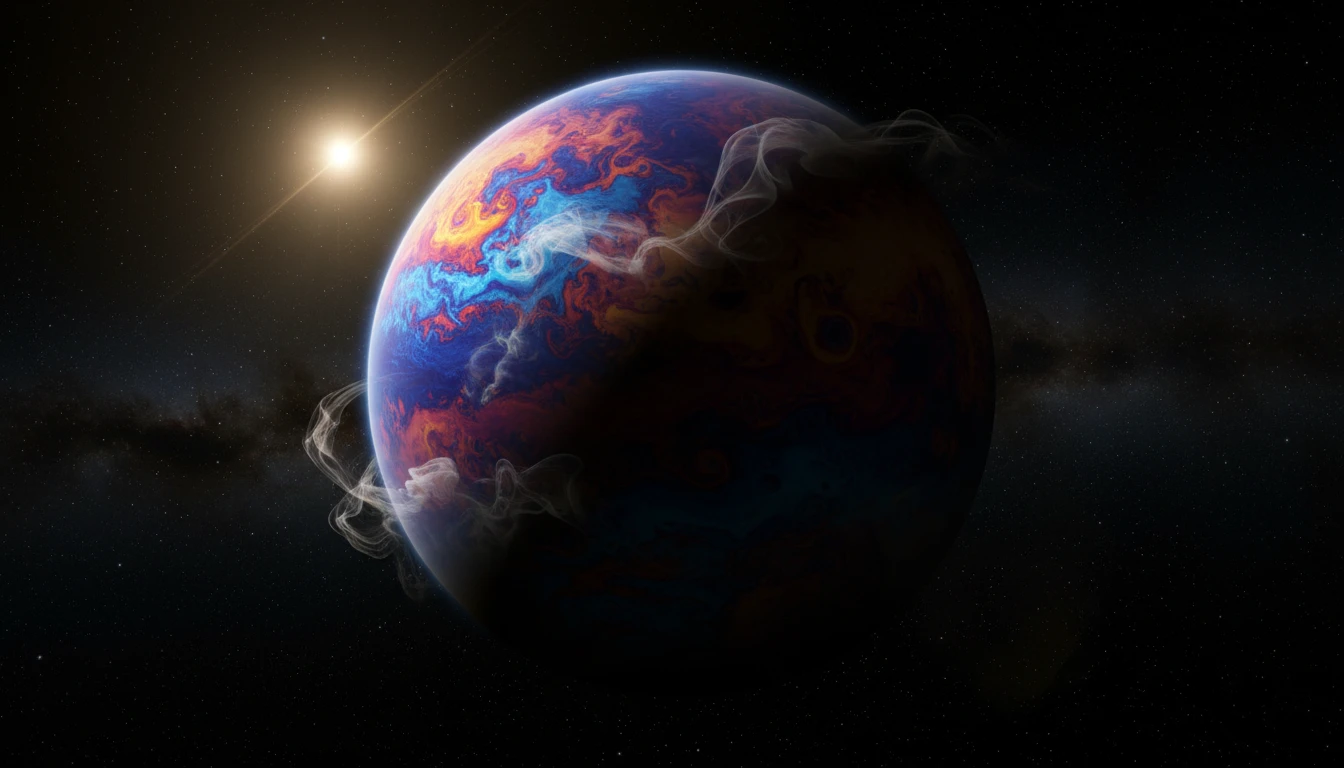
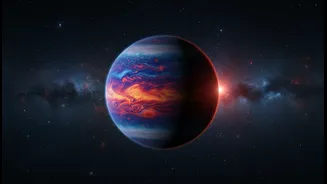
One of the most compelling pieces of evidence is the exoplanet WD 1856 b. Discovered in 2020, this Jupiter-sized giant planet orbits a white dwarf just 80 light-years from Earth. What puzzled scientists was its incredibly tight orbit—it whips around its dead star every 34 hours, far closer than Mercury orbits our Sun. By all accounts, it should have been destroyed when its star became a red giant. The discovery raised a critical question: how did it get there and survive? Recent analysis using the James Webb Space Telescope (JWST) may have finally solved the mystery.
Solving the Puzzle with a Thermal Clock
New observations of WD 1856 b's atmosphere revealed its temperature, which was hotter than could be explained by the dim light of its white dwarf star. Because gas giants cool at predictable rates, researchers used this temperature data like a thermal clock to reconstruct the planet's history. The findings suggest the planet didn't start in its current, perilous position. Instead, it stayed at a safe, wide orbit during its star's destructive red giant phase. Then, billions of years later, gravitational nudges likely from other stars in its triple-star system caused it to migrate inward toward the white dwarf. This inward journey, a process of tidal heating, warmed the planet up, explaining its current temperature. It survived by staying away during the initial danger and only moved in long after the coast was clear.
A Glimpse into Our Solar System's Future
The survival story of planets like WD 1856 b provides a preview of our own solar system's distant future. It confirms that planets, particularly giant ones like Jupiter and Saturn, can indeed survive the death of their star if they are far enough away. While the inner solar system will be devastated, the outer realms could persist for billions of years, orbiting the faint, cooling ember of the Sun. This research widens the possibilities for where and when planets might exist. It shows that stellar death is not the end for every world; for some, it is the beginning of a new, quieter chapter in a long cosmic life.