







A Steamy World, Light-Years Away
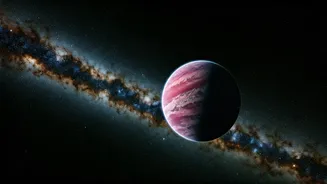
The subject of this groundbreaking observation is a planet known as GJ 1214 b, located about 40 light-years from Earth. This isn't an Earth-like world, but rather a 'mini-Neptune'—a class of planet more massive than Earth but smaller than Neptune, and
one that is surprisingly common in our galaxy, yet absent from our own solar system. For years, GJ 1214 b has been a source of mystery. Previous observations were blocked by a thick, impenetrable layer of haze or clouds, leaving astronomers to wonder what lay beneath. Now, thanks to the Webb telescope's powerful infrared vision, we've finally pierced that veil. The findings paint a picture of a water-rich world, but not one with serene oceans.
How Webb Uncovered a Cosmic Secret
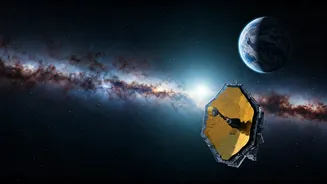
So how exactly does a telescope see water from trillions of kilometres away? The technique is called transit spectroscopy. As GJ 1214 b passes in front of its host star, a tiny fraction of the starlight filters through the planet's atmosphere. Different molecules in the atmosphere absorb light at specific wavelengths, leaving a unique chemical fingerprint in the light that reaches the telescope. The James Webb Space Telescope's Mid-Infrared Instrument (MIRI) is exquisitely sensitive to these signatures. By capturing a 'heat map' of the planet as it orbited its star, scientists could analyse the atmospheric composition with unprecedented detail, confirming the tell-tale signs of water vapour.
Not a Tropical Paradise
While the presence of water is exciting, it’s crucial to manage expectations. GJ 1214 b is not a habitable world. The planet is tidally locked, meaning one side always faces its star, and it gets incredibly hot, with dayside temperatures reaching around 280 degrees Celsius. The water detected is likely in the form of a thick, hot steam that makes up a significant part of its atmosphere. Researchers believe the planet is blanketed by a highly reflective layer of haze or clouds, creating a steamy, otherworldly environment. So, while you wouldn't be packing your swimsuit for a trip to GJ 1214 b, the discovery is still a monumental achievement for astronomy.
Solving the Mini-Neptune Mystery
The real significance of this discovery lies in what it tells us about how planets form. Mini-Neptunes are everywhere in the Milky Way, but we have none to study up close. Understanding GJ 1214 b is key to understanding this common class of planet. The presence of water and other heavier molecules, rather than a primordial atmosphere of light hydrogen and helium, provides crucial clues to its past. It suggests the planet may have formed farther out from its star, where water ice is abundant, before migrating to its current hot orbit. This single observation helps astronomers test and refine their theories on planetary evolution, solving a major puzzle in astrophysics.
A Stepping Stone to Finding Other Earths
Every find like this serves as a critical proof of concept. The successful analysis of GJ 1214 b's hazy atmosphere demonstrates that the JWST can do exactly what it was designed for: characterising the atmospheres of distant worlds with incredible precision. This capability is now being applied to other, potentially more hospitable targets, including smaller, rocky planets in the habitable zones of their stars, such as those in the TRAPPIST-1 system. The search for water on those worlds is a primary goal. This discovery on a 'mini-Neptune' is a vital stepping stone, honing the techniques that may one day lead to the discovery of a true Earth-like world with liquid water oceans.