





The Allure of Super-Earths
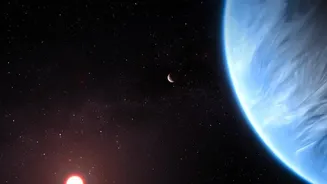
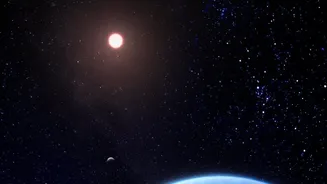
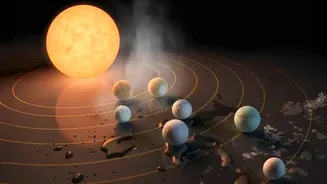
Super-Earths are a fascinating and common type of exoplanet in our galaxy. Larger than Earth but smaller than ice giants like Neptune, they represent a class of planet that doesn't exist in our own solar system. These worlds can be rocky like Earth or have
a composition that includes significant amounts of water. Their size and potential for holding onto an atmosphere make them prime candidates in the search for habitable environments. But because they are light-years away and incredibly faint compared to their parent stars, studying them requires extraordinary technology and clever techniques. The key question scientists want to answer is: do these planets have atmospheres, and if so, what are they made of?
Decoding Alien Air with Light
The primary method JWST uses is called transit spectroscopy. Imagine watching a distant streetlight and seeing a moth fly in front of it. The light dims slightly. Now, imagine you could analyze the light that passes through the moth's nearly transparent wings. You might learn something about their structure. This is the principle behind transit spectroscopy. When an exoplanet passes, or 'transits', in front of its host star from our perspective, the star's light dims by a tiny, measurable amount. A fraction of that starlight filters through the planet's atmosphere before reaching Webb's mirrors.
Webb's Infrared Advantage
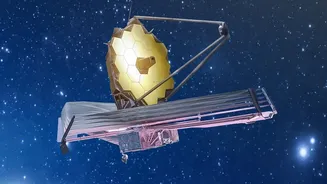
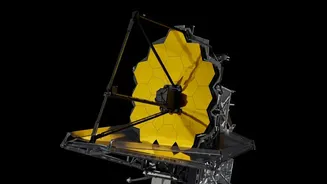
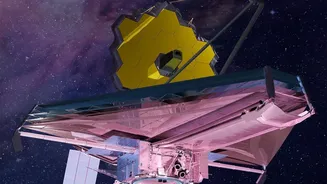
This is where high-precision infrared spectroscopy comes in. Different chemical elements and molecules in an atmosphere absorb specific wavelengths, or colors, of light. By looking at which parts of the light spectrum are missing after passing through the atmosphere, scientists can identify the chemical fingerprints of gases like water, methane, and carbon dioxide. The James Webb Space Telescope is uniquely powerful because it is optimized to see in the infrared range. This part of the spectrum is where many key molecules leave their most prominent absorption signatures, information that is invisible to telescopes that primarily see visible light. Webb's enormous mirror and sensitive spectrographs, like NIRSpec and MIRI, can capture these faint signals with unprecedented clarity.
A Glimpse of a Molten World
A prime example of this technique in action is the study of 55 Cancri e, a scorching hot super-Earth located 41 light-years away. This planet orbits so close to its star that its surface is likely a bubbling ocean of molten magma. For years, astronomers debated whether a planet under such intense heat could even hold onto an atmosphere. Using its infrared instruments, JWST measured the thermal emission—the heat radiating from the planet. The dayside was cooler than expected if it were just bare rock, suggesting that an atmosphere was circulating heat from the hot side to the cooler, perpetually dark nightside. The data pointed towards a secondary atmosphere, possibly rich in carbon monoxide or carbon dioxide, being continuously replenished by gases bubbling out of the magma ocean. This was the best evidence to date of an atmosphere around a rocky planet outside our solar system.
The Building Blocks of Habitability
While a lava world like 55 Cancri e is far from habitable, the ability to detect and characterize its atmosphere is a monumental step. It proves that JWST can perform this delicate analysis on much smaller, rockier worlds than was previously possible. Each observation hones the techniques needed to eventually study more temperate, Earth-like planets. By identifying the presence of carbon-bearing molecules and water vapor, astronomers are not just cataloging chemicals; they are searching for the fundamental ingredients that could support life as we know it. The telescope's power allows scientists to distinguish between different atmospheric models and begin to understand the rich diversity of planetary environments across the cosmos.