




A New Cosmic Detective on the Scene
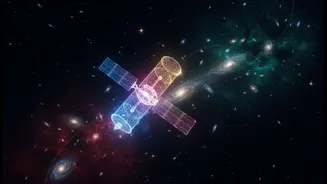
Think of the Roman Telescope as Hubble's wide-eyed cousin. While it has the same size primary mirror as the Hubble Space Telescope, its main camera, the Wide Field Instrument, will capture a patch of sky at least 100 times larger in a single shot. This
means that while Hubble and the James Webb Space Telescope (JWST) provide deep, narrow glimpses into the cosmos, Roman is built for speed and scale, creating vast panoramic maps of the infrared universe. This incredible efficiency will allow it to conduct massive surveys that would take other telescopes centuries to complete. The mission, named after NASA's first chief of astronomy, Nancy Grace Roman, is designed to investigate three core mysteries: the nature of dark energy and dark matter, the census of planets beyond our solar system, and the evolution of the cosmos.
Unmasking the Universe's Dark Side
Dark matter makes up about 27% of the universe, but since it doesn't emit or reflect light, it remains invisible and mysterious. Roman will map its presence by using a phenomenon predicted by Einstein called gravitational lensing. The immense gravity of foreground galaxies, including their dark matter, bends and magnifies the light from more distant galaxies behind them. Roman is expected to find a staggering 160,000 of these gravitational lenses. By studying the subtle distortions in the images of background galaxies, scientists can measure how dark matter is distributed and clumped together. This will provide crucial clues about its fundamental nature and how it shaped the structure of the universe we see today.
Taking a Galactic Planet Census
While thousands of exoplanets have been found, most detection methods are biased towards finding large planets orbiting very close to their stars. Roman will pioneer the use of a space-based microlensing survey to find thousands of new worlds. This technique works by watching for the momentary brightening of a distant star, which occurs when a closer star and its planets pass in front of it, acting as a natural cosmic lens. This method is sensitive to planets with masses down to that of Mars, and it can find them at a wide range of distances from their star, including in the habitable zone and even free-floating 'rogue' planets that don't orbit a star at all. Scientists predict Roman could find over 1,000 planets through microlensing and potentially another 100,000 using the traditional transit method, dramatically expanding our catalogue of known worlds.
Mapping Billions of Galaxies
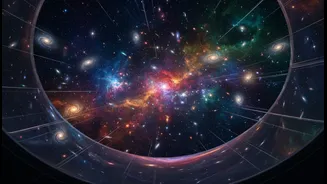
To understand how the universe evolved and why its expansion is accelerating, we need to map its large-scale structure through time. Roman's High-Latitude Wide-Area Survey will do just that, creating 3D maps of the cosmos by observing hundreds of millions of galaxies. By combining imaging and spectroscopy—splitting light into its component colours—the survey will precisely measure the positions and distances of galaxies, tracing the history of cosmic expansion. Its enormous field of view will also allow it to study how galaxies form and grow within their cosmic environments. The sheer volume of data will provide an unprecedented statistical look at our universe, helping to refine our cosmological models and perhaps uncover entirely new cosmic phenomena.