






A Mission Beyond GPS
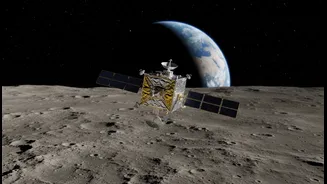
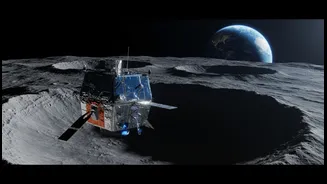
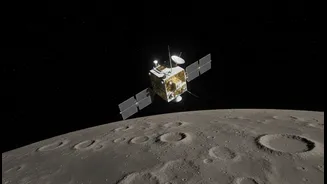
Launched in June 2022, the Cislunar Autonomous Positioning System Technology Operations and Navigation Experiment (CAPSTONE) had a clear primary goal: to test an entirely new way for spacecraft to navigate in deep space. The mission successfully demonstrated
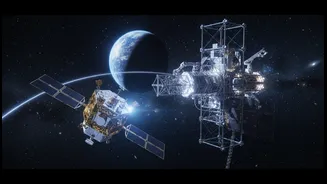
its Cislunar Autonomous Positioning System (CAPS), which allows a spacecraft to determine its position relative to other lunar orbiters, like NASA’s Lunar Reconnaissance Orbiter (LRO), without constantly relying on signals from Earth. This is a crucial step toward a future where the cislunar environment—the space around the Moon—is bustling with activity. By proving this technology works, CAPSTONE has laid the groundwork for a future where lunar missions can operate with greater independence, reducing the strain on Earth's limited Deep Space Network. NASA officially declared the mission's primary objectives complete in July 2026, but the spacecraft's journey is far from over.
Is the 'Gateway' Orbit Truly Stable?
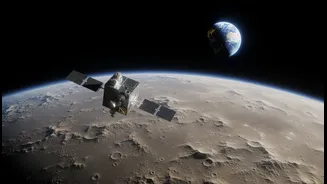
CAPSTONE's second major task was to be the first spacecraft to fly in a unique Near-Rectilinear Halo Orbit (NRHO). This highly elliptical path was chosen for the planned Lunar Gateway, a future outpost in lunar orbit, because computer simulations showed it to be remarkably stable. The orbit uses a precise balance point between the gravities of the Earth and Moon, requiring minimal fuel for a spacecraft to maintain its position over the long term. CAPSTONE's multi-year presence in this orbit has moved this concept from theory to proven reality. The mission has provided invaluable real-world data, confirming the stability and characteristics of the NRHO. This validation is critical, as it reduces the risk and cost for all future missions intending to use this path, even with the cancellation of the original Gateway station plans, as the orbit itself remains valuable for future infrastructure.
A Pathfinder for Commercial Partnerships
Perhaps one of CAPSTONE's most significant legacies is the operational model it represents. The spacecraft is owned and operated not by NASA, but by a private company, Advanced Space of Colorado. The mission was developed under a fixed-price contract, representing a new, more commercial way for NASA to conduct business. This approach allows the agency to test high-risk, high-reward technologies more quickly and affordably than through traditional government-led programs. The success of CAPSTONE, a relatively low-cost CubeSat, serves as a powerful proof-of-concept for this public-private partnership model. It demonstrates that small, agile commercial partners can play a vital role in executing key aspects of the nation's ambitious space exploration goals, paving the way for similar collaborations in the Artemis era.
A Flexible, Upgradable Tech Testbed
After completing its primary objectives, CAPSTONE's mission was extended, transforming it from a single-purpose pathfinder into a versatile technology testbed in lunar orbit. Rather than launching new satellites, engineers demonstrated that new software and experiments could be uploaded to the existing spacecraft. This allowed CAPSTONE to test other critical technologies, including autonomous onboard maneuver planning and advanced communication protocols like Delay/Disruption Tolerant Networking (DTN), which is designed to handle the long delays and signal gaps inherent in deep space communication. This ability to upgrade a spacecraft in flight represents a paradigm shift, creating a more sustainable and cost-effective model for long-term technology development in space. The data gathered will now inform the development of future communication and navigation systems for a sustained human presence on the Moon.