





The Old Way: A Supercomputer Symphony
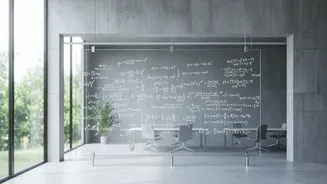
Traditionally, predicting the weather has been a monumental task of physics and mathematics. Known as Numerical Weather Prediction (NWP), this method involves dividing the Earth's atmosphere into a massive 3D grid. Supercomputers then spend hours solving
complex fluid dynamics equations for every single box in that grid, simulating how temperature, pressure, and wind will evolve over time. While incredibly powerful, this approach has inherent limitations. A 10-day global forecast can require a warehouse-sized supercomputer to run for hours, consuming immense energy. Increasing the forecast's detail or resolution requires an exponential leap in computing power, creating a practical ceiling on how granular a timely forecast can be.
The New Approach: AI Learns from the Past
Instead of solving physics equations from scratch, AI models treat weather forecasting as a giant pattern-recognition problem. They are trained on decades of historical weather data, such as the comprehensive ERA5 dataset, which contains hourly records of global weather spanning 40 years. By analysing this vast trove of information, deep learning networks learn the complex, non-linear relationships between different atmospheric states. In essence, the AI learns how a specific set of conditions today has historically transitioned into a new state tomorrow. It doesn't need to calculate the underlying physics; it recognises the pattern and predicts the most likely outcome based on what it has seen before.
The AI Game-Changers
Several major technology players have developed AI models that are revolutionising the field. Google DeepMind's GraphCast can produce a highly accurate 10-day forecast in under a minute on a single machine. Huawei's Pangu-Weather, which uses a 3D Transformer architecture, is reportedly 10,000 times faster than traditional systems and has shown particular strength in tracking tropical cyclones. Other significant models include NVIDIA's FourCastNet and Microsoft's Aurora, each leveraging unique AI architectures to achieve incredible speed and accuracy. The European Centre for Medium-Range Weather Forecasts (ECMWF), long considered the gold standard in NWP, has even made its own AI-based model, AIFS, operational.
A Leap in Speed and Accuracy
The performance of these AI models is not just an incremental improvement; it's a paradigm shift. The speed is the most obvious advantage—what took hours on a supercomputer now takes seconds or minutes on a single GPU. This allows for more frequent updates and the ability to run large 'ensembles' (many forecast variations) to better gauge probability. But speed isn't the only story. In benchmark tests, Google's GraphCast outperformed the leading traditional model from ECMWF on over 90% of verification targets. This enhanced accuracy, especially in medium-range forecasts, provides a clearer picture of events like atmospheric rivers and developing storms, offering longer lead times for preparation.
Humans and Hybrids Still Essential
Despite their power, AI models have limitations. Because they learn from historical data, they can struggle to predict events that are truly unprecedented, such as record-shattering heatwaves or 200-year floods that fall outside their training scope. They are effectively black boxes, making it difficult for scientists to understand precisely why a certain prediction was made. For this reason, the future of weather forecasting is likely to be a hybrid one. AI can provide a rapid, highly accurate baseline forecast, which human meteorologists can then analyse, interpret, and refine using their expertise and traditional physics-based models. This approach combines the speed of AI with the physical understanding and judgment of human experts.